
Amazon's Subscribe & Save is Dead
Updated May 18, 2026: We’ve added a new section below on why we believe Amazon really made this change — and how it ties directly to the FTC’s $2.5 billion “dark patterns” settlement.
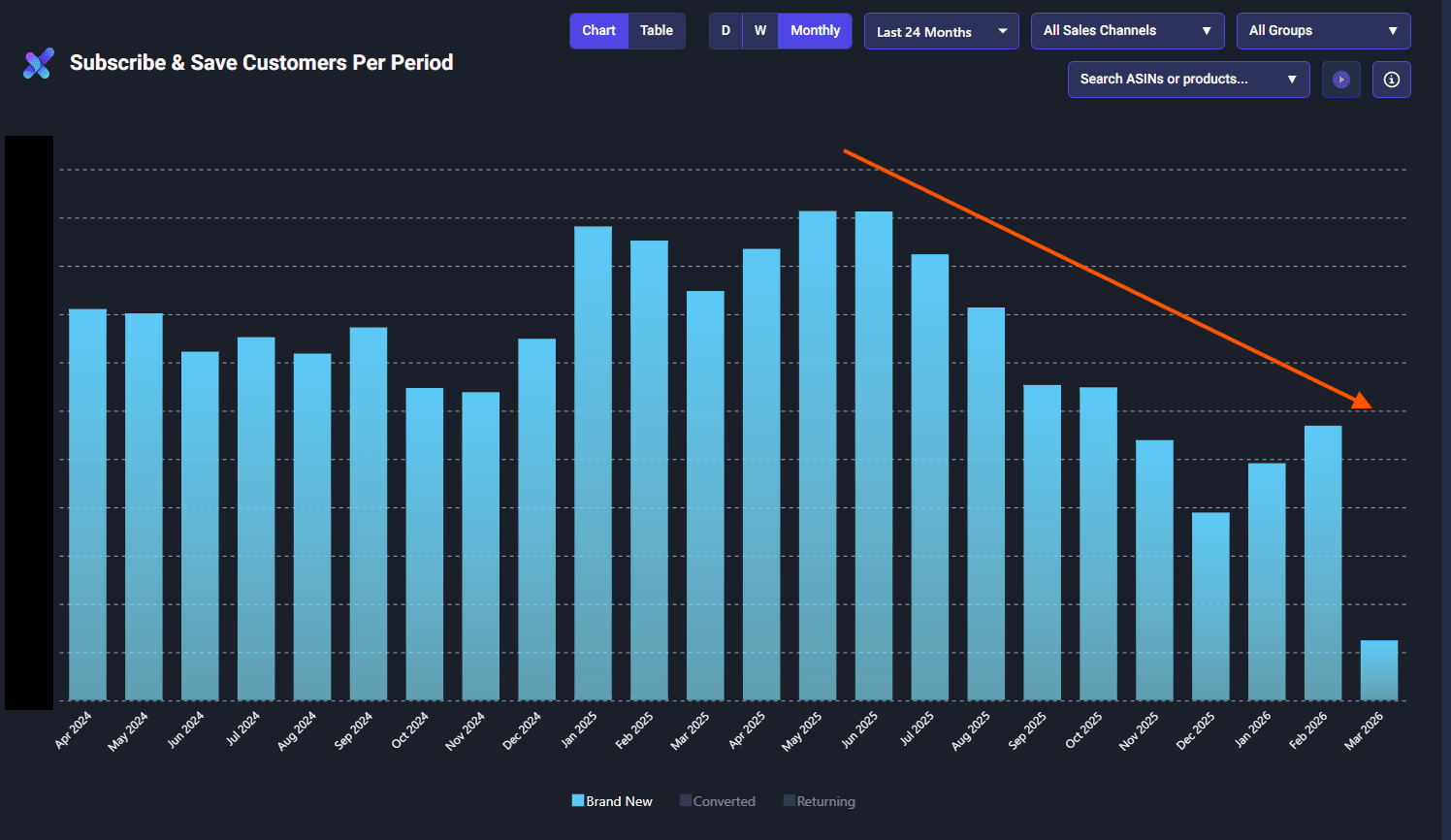
Amazon fundamentally changed their Subscribe & Save program around July 2025 and most brands still haven’t figured out what happened.
ExpandFi runs customer analytics for $6 billion worth of Amazon sellers. Starting in July, we watched new subscriber acquisition fall off a cliff across multiple brands. Not a dip. A structural collapse. New subscriber revenue as a share of total Amazon revenue dropped nearly 50% within seven months. The subscription rate — new subscribers as a percentage of total customers — got cut in half. This wasn’t one brand having a bad quarter. We saw the same pattern across every S&S-dependent account on our platform.
Here’s what we believe happened. Amazon changed the Buy Box default. Subscribe & Save used to be pre-selected. Now it’s not. The customer has to actively choose it. And most customers take the path of least resistance. They just click buy.
Amazon’s intent was probably to reduce cancellation rates, which were running north of 35% and were a mess. And it worked — cancellations came down significantly. But they solved one problem by creating a much bigger one. The subscribers who do still come in aren’t even better. 3-month LTV declined. Retention dropped. Fewer subscribers AND worse subscribers. Worst possible outcome.
But reducing cancellations probably wasn’t the only reason — or even the main one. There’s a bigger force behind this change, and it’s regulatory.
In September 2025, the FTC secured a historic $2.5 billion settlement with Amazon over what it called “dark patterns” — deceptive interface designs that nudged customers into Prime subscriptions and made them hard to cancel. The deal: $1 billion in penalties, $1.5 billion refunded to roughly 35 million customers, and a mandate to stop pre-selecting and pre-enrolling people into recurring charges.
Now look at what Subscribe & Save used to be. A pre-checked option sitting in the Buy Box. A recurring charge the customer never actively chose. That is the textbook definition of the exact pattern the FTC just fined Amazon $2.5 billion for.
We don’t think the timing is a coincidence. Amazon didn’t quietly remove the Subscribe & Save default in mid-2025 purely to tidy up cancellation rates. They did it because pre-selecting a subscription — anywhere on the platform — had become a legal liability. The FTC trial was bearing down. Stripping the auto-select out of Subscribe & Save was almost certainly part of Amazon cleaning house before the settlement landed.
If that’s right, this matters far more than a UI tweak. It means Subscribe & Save as a default-on, friction-free enrollment engine isn’t coming back. This is a compliance change, not a growth experiment Amazon reverses next quarter. The program will keep existing — but from here on, only customers who genuinely want a subscription will end up in one. Plan your customer file around that reality, not the old one.
Now here’s the part that most brands are missing entirely, because they don’t have the data to see it.
The customers didn’t disappear. They just stopped subscribing.
We track revenue by customer state — New Subscriber, Returning Subscriber, New Non-Subscriber, Returning Non-Subscriber. Four buckets. When you watch these four lines move over time, the picture becomes obvious.
As new subscriber share collapsed, returning non-subscriber share grew by roughly the same amount. An 8 percentage point swing from one bucket to the other over the course of a year. Those customers are still buying. They’re just not locking into subscriptions anymore. They’re coming back on their own terms, purchasing when they want, and you can’t predict when that next order is coming.
That is a fundamentally different business than the one most Amazon sellers think they’re running.
If you built your forecast around subscription revenue growth, your model is wrong. If you built your inventory planning around predictable S&S reorder cycles, your safety stock assumptions are wrong. If you’re measuring customer health by subscriber count, you’re measuring the wrong thing.
The revenue didn’t vanish. It migrated. From a predictable, recurring bucket into an unpredictable, behavior-driven one. The P&L might look similar month to month. The underlying structure of your customer file has changed completely.
Most sellers I talk to know something feels off. They can see subscriber numbers declining. What they can’t see — because Amazon doesn’t show it to them — is where those customers actually went. They assume the worst. They think they’re losing customers. They’re not. They’re losing visibility.
That’s the real cost of not having customer-level analytics.
We built ExpandFi specifically to answer this kind of question. Not “what are my sales” but “who is buying, how has their behavior changed, and what does that mean for the next 90 days.” We made this shift visible to our customers months before most sellers even noticed something was wrong.
If your Subscribe & Save numbers have been declining since mid-2025 and you don’t have a clear picture of where that revenue went, you’re operating blind during a structural shift in how Amazon customers buy.
We can show you exactly what’s happening inside your customer file.