
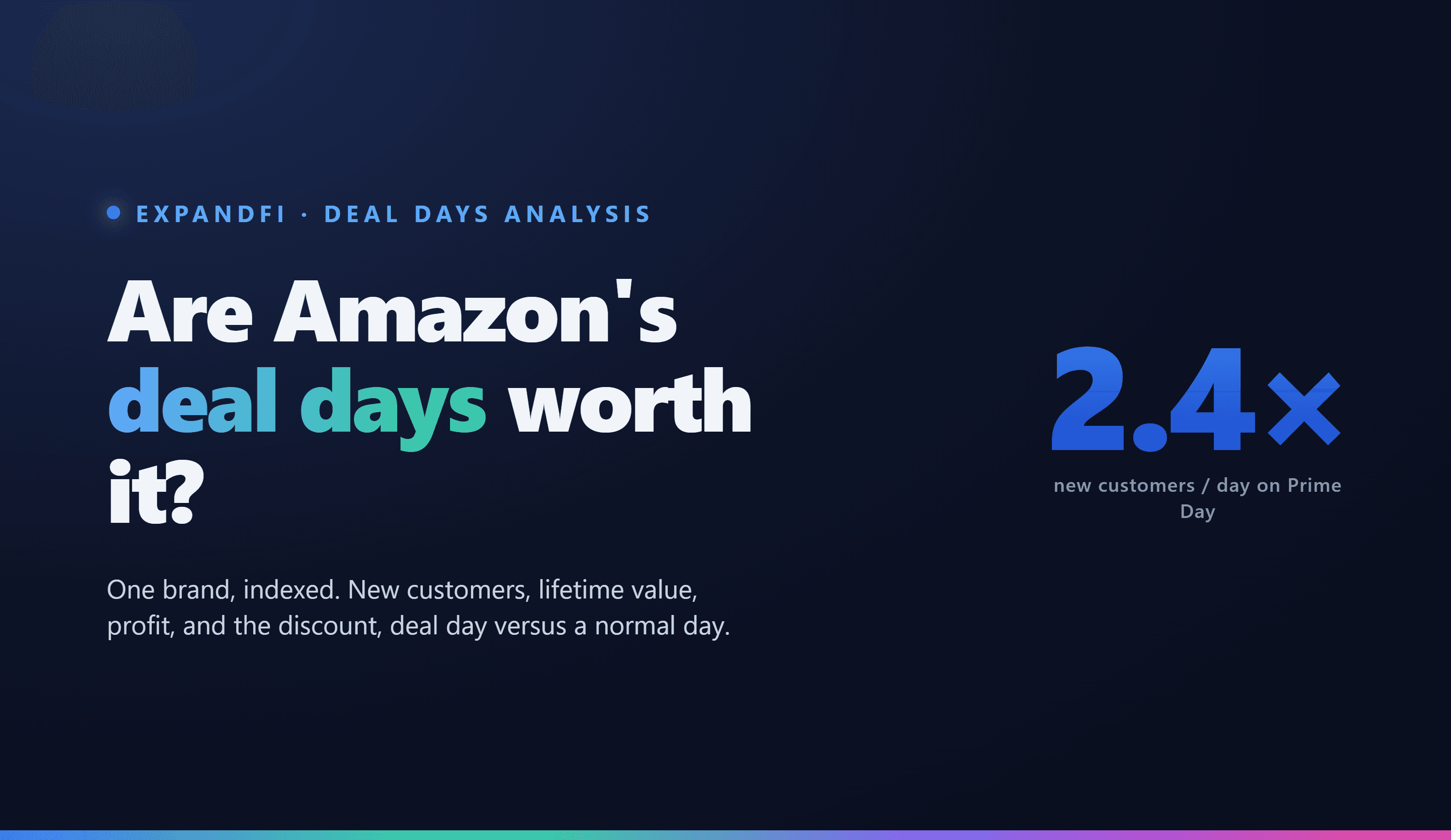
Are Amazon's deal days worth it?
Quick note: This is one brand on Amazon, a consumable category, and every figure is indexed or shown as a percentage so nothing identifying is exposed. Treat it as a method to copy, not a benchmark to quote.
Every July the same debate runs in seller chats. Prime Day moved a mountain of units, but did it move the business? Event-day revenue is the easy number to celebrate and the wrong one to manage. A discount day will always post a big top line. What actually matters is the customer you kept.
So we ran the question the way an operator should: cohort by cohort. We compared customers acquired during each Amazon deal event against a matched set of customers acquired on normal days around the same event. Same season, same maturity, like for like. Then we followed them for up to a year. Everything below is indexed, so the shape of the story is real while the private revenue stays private.
Prime Day was the best new-customer day
Start with raw acquisition. How many brand-new customers did each event bring in per day, compared with a matched normal day? A normal day is 1.0x.
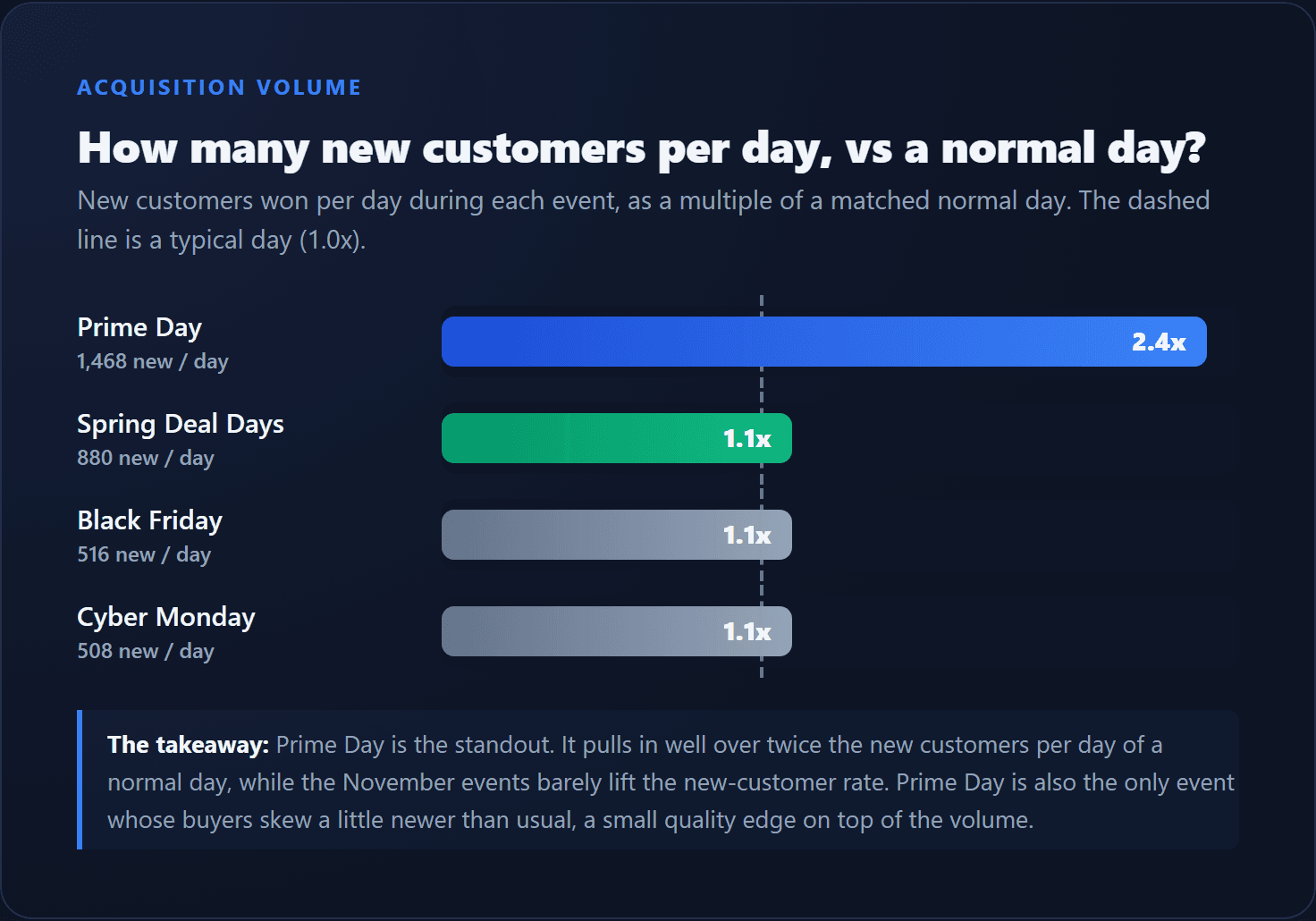
That gap is the first useful result. If you think of Prime Day as a discount you pay to reach customers you would not otherwise get, the data backs you up: it more than doubles your new-customer rate. Black Friday and Cyber Monday barely move it. They run on the same discount mechanics but do a different job, rewarding people already in your file rather than finding new ones.
A discount day always posts a big top line. The question is whether it leaves behind a customer worth having.
But are those customers worth as much?
Acquisition is only half the trade. A new customer is a good deal only if they come back. So we indexed each Prime Day cohort’s 12-month revenue and 12-month profit against a matched normal-day customer from the same year, set to 100.
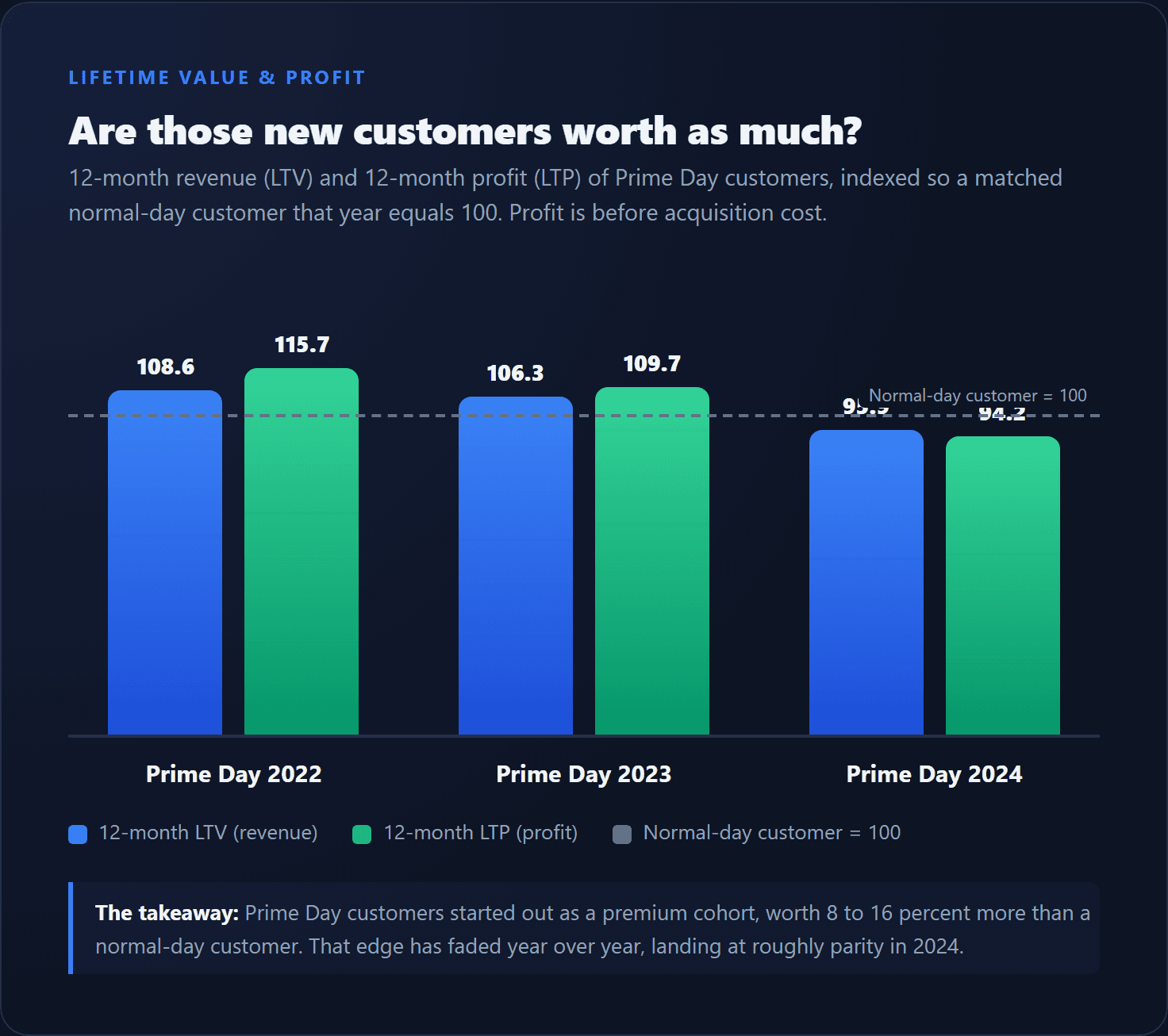
In 2022 and 2023, Prime Day customers were a premium cohort, worth eight to sixteen percent more over their first year than a normal-day customer. By 2024 that edge had eroded to roughly even. The discount is not poisoning the cohort. These are not worse customers. But the quality premium that used to ride along with Prime Day acquisition is converging toward average. For an operator, that trend line matters more than any single year.
The discount-versus-mix trap
On Prime Day 2024 the brand gave a much deeper discount than usual, close to three times the normal promo depth. You would expect the average selling price to drop. It rose.
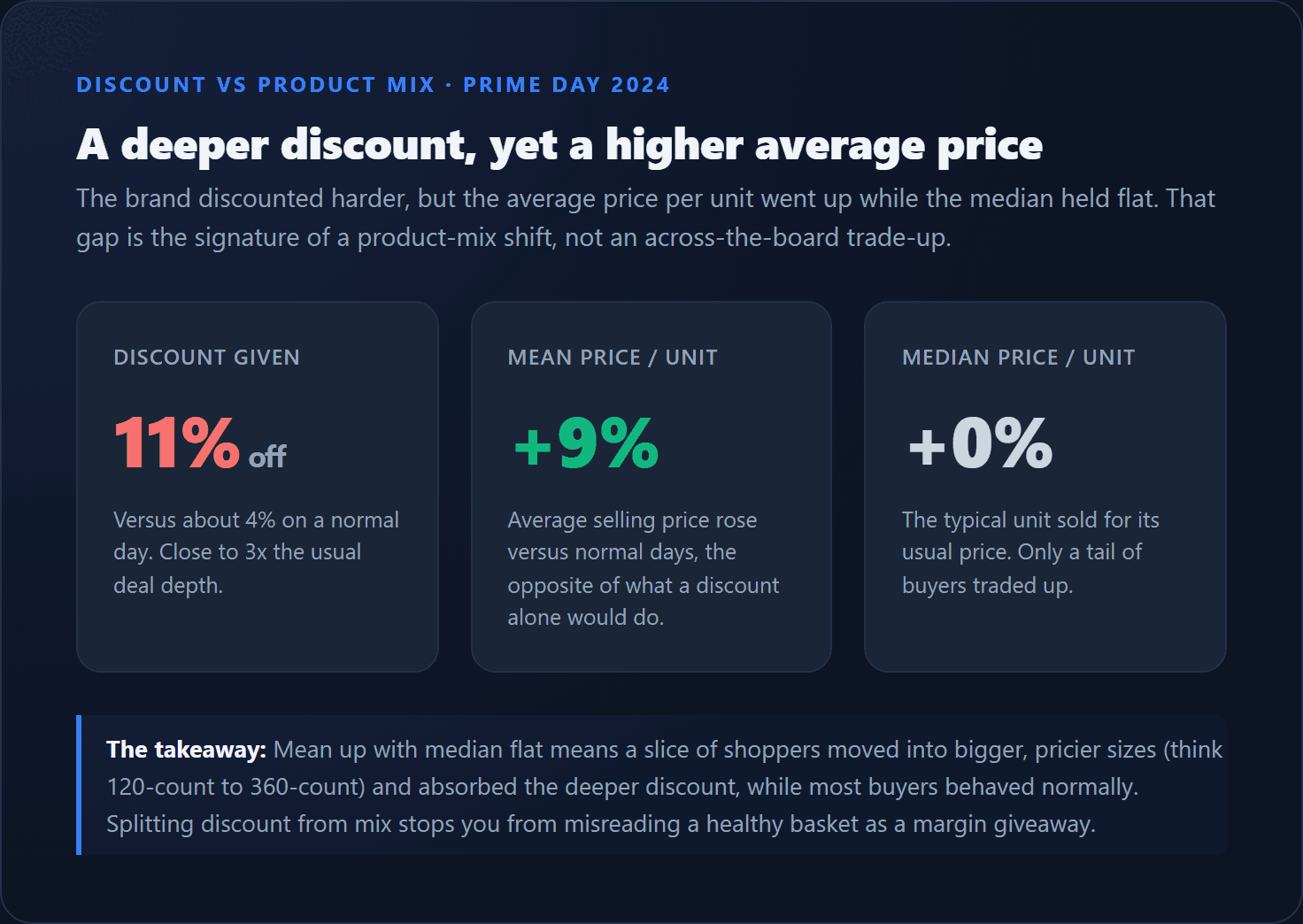
The tell is mean versus median. The mean price per unit went up while the median stayed flat. You are not looking at everyone trading up. You are looking at a tail of shoppers sizing up, the kind who jump from a 120-count to a 360-count when the per-unit price drops. Read only the discount and you would swear you gave away margin. Read the mix too and you see customers self-selecting into bigger commitments.
Now that we track CAC
The profit figures above are before acquisition cost. They come from matured cohorts acquired in 2022 to 2024, which is the right like-for-like for a full twelve-month read today, but those years predate per-customer cost tracking.
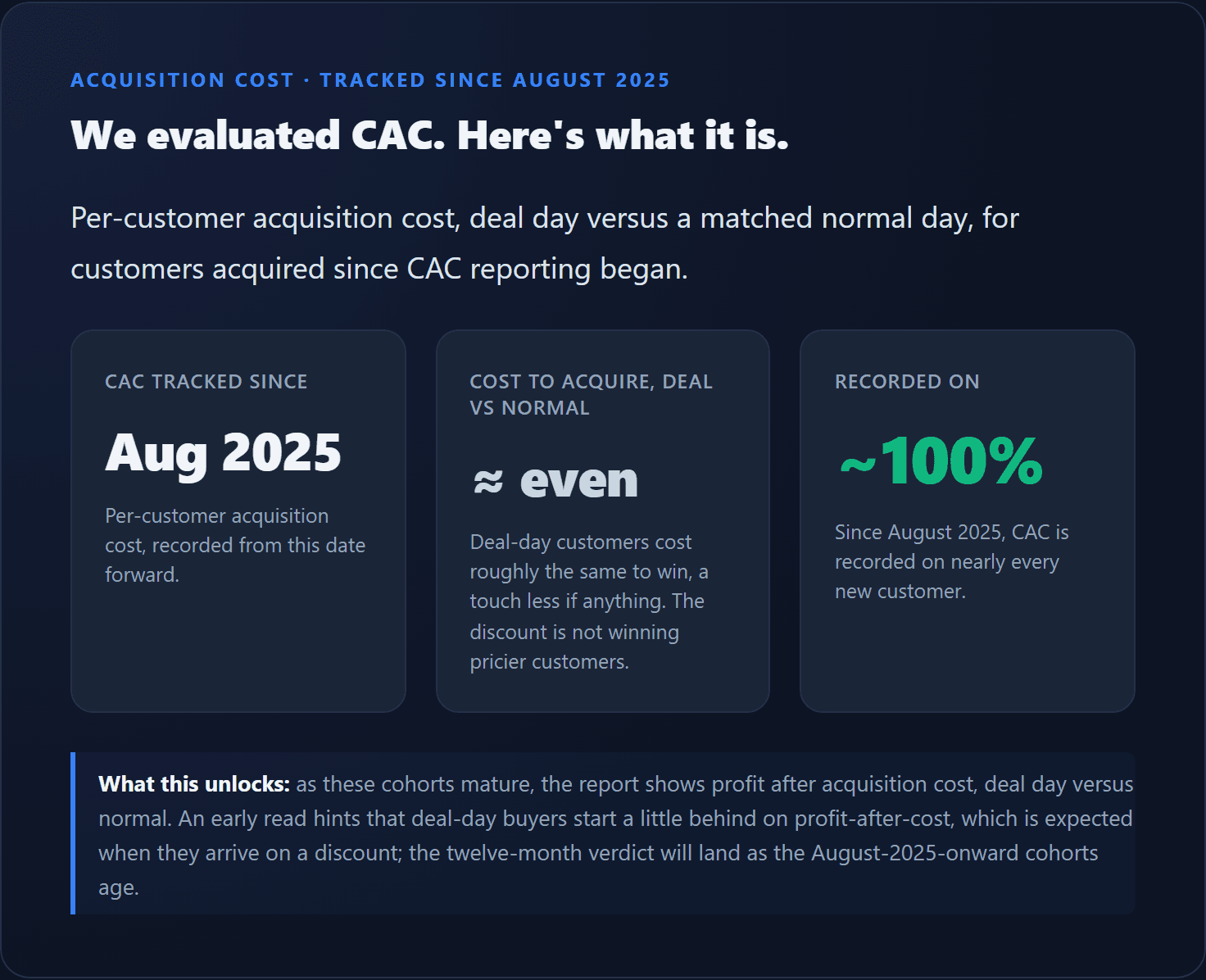
We also evaluated CAC directly. ExpandFi began recording per-customer acquisition cost for this brand in August 2025, so for customers acquired since then we can compare it head to head. The cost to acquire a deal-day customer and a normal-day customer is basically the same, a touch lower on deal days if anything. The discount is not buying more expensive customers. The full after-cost lifetime read on these cohorts is still maturing, because they are only months old, and the report fills it in as they age.
So, better or worse?
Putting it together for this brand: Prime Day customers are about as valuable as a normal-day customer over their first year, and Prime Day was the single best day for bringing in genuinely new ones. It is an acquisition event, not a premium-customer event. The discount buys reach, the customers it reaches are roughly average in value, and a useful minority quietly trade up into your larger sizes.
That is a perfectly good reason to run Prime Day. It is a poor reason to expect it to mint your best customers. Plan it as a top-of-funnel push, measure it on the cohort it leaves behind, and watch the year-over-year quality line so you notice the day a volume event stops paying its way.
Run it on your own store
None of this needed a data team. Every chart here came from the Amazon Deal Days vs. Regular Days report, now live for every ExpandFi merchant. It lines up each deal-event cohort against a matched normal-day cohort across new-versus-returning mix, new customers per day, lifetime value, lifetime profit, and the mean-versus-median price split, for Prime Day, Spring Deal Days, Black Friday, and Cyber Monday.
Get your own answer
If you are an ExpandFi user, open the Amazon Deal Days vs. Regular Days report and explore your own numbers. Or go a step further: hand this entire post to Claude through the ExpandFi MCP and ask it to run the same analysis on your data. It will pull your cohorts and tell you whether your deal days are acquisition wins or just discounts. The point is not to take our one brand’s answer. It is to get yours.
This is one brand’s data. We strongly recommend you look at your own before making any decisions. One brand, Amazon channel, consumable category, indexed for privacy. Customers are grouped by the event their first-ever purchase fell into, and compared to customers acquired in the surrounding 60-day window, excluding other deal events, so both groups share the same season and the same amount of time to mature. Value figures use fully matured 12-month cohorts. A durable-goods brand, a heavy subscription brand, or a different price ladder could see very different numbers. Your business is not this one. Use your own report.