
How bad are Amazon's Seller fees actually?
Saw the Forbes piece about Amazon sellers leaving for TikTok over rising fees.
Instead of debating it, I decided to use ExpandFi.com and our Amazon Fee Agent (releasing soon) to look into my own account. I pulled my actual settlement data and saw what my fees really were, and how they’d changed over the last 5 years (2021 to 2025).
Quick note: I kept this anonymized. Prices, per-unit fees, and revenue are shown indexed (2021 = 100) or as percentages, so nothing identifying is exposed. The only real dollars are Amazon’s own published rates. Full tables are in the images.
TLDR
Over five years, Amazon’s fees on my best product fell as a share of price, from 33.7% to 31.2%. Amazon’s per-unit fee did rise (about +20%), but I raised price faster (about +30%), so the burden dropped. At the account level, structural “behavior-era” fees are still under 1% of revenue, the punitive fees (low-inventory, aged-storage) never hit me, and reimbursements offset nearly the entire structural fee stack. The “fees are crushing sellers” story describes a big, bulky, slow-turning, overstocked operator. That is the opposite of a disciplined small-and-light brand.
1) The hero product
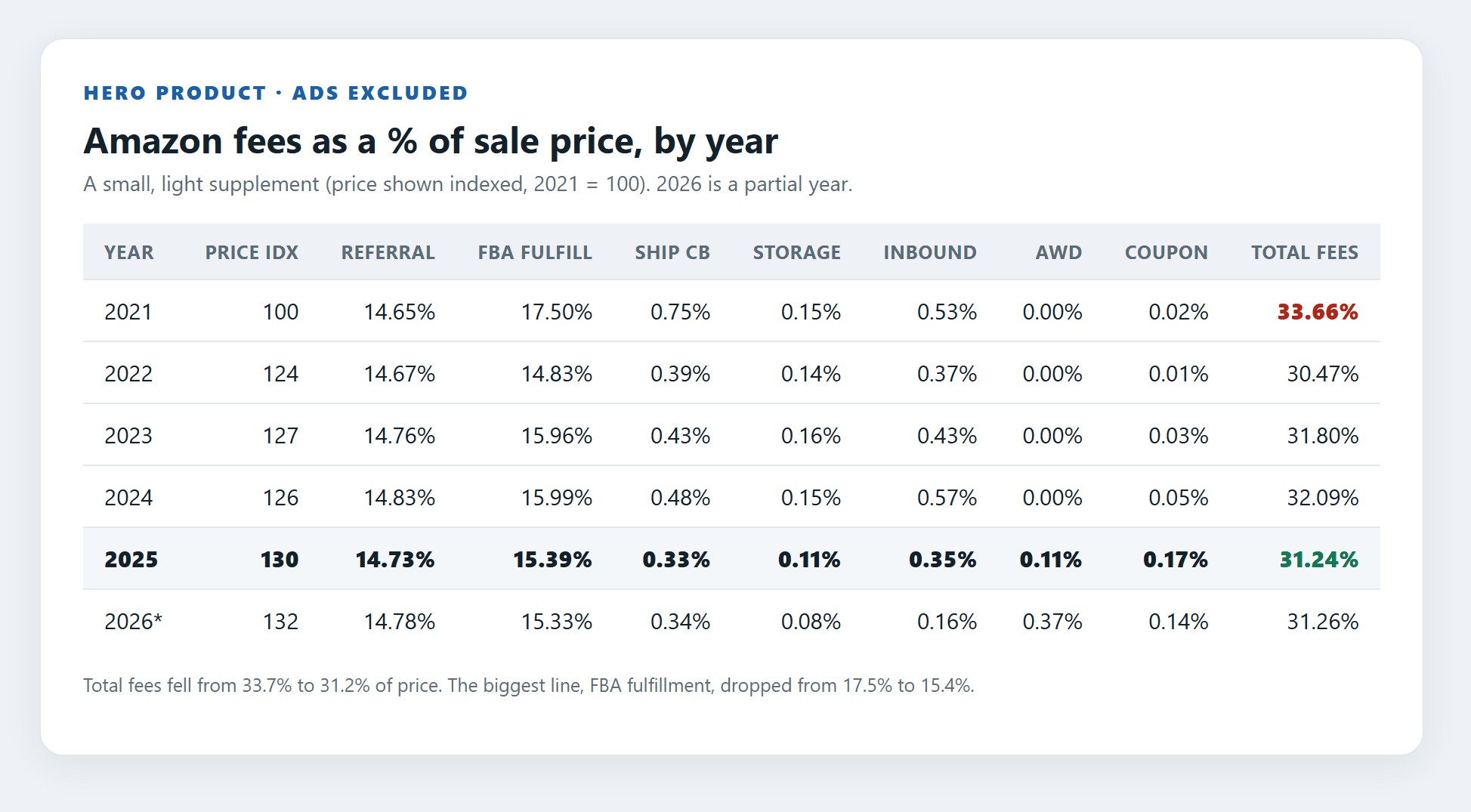
One product, a small, light supplement, is more than half my Amazon revenue, so its fee trend is my fee story. Every Amazon fee on it, ads excluded, as a % of the sale price:
- Fees as % of price: 33.7% to 31.2% (down 2.4 pts)
- Amazon fee per unit (indexed): 100 to 120 (+20%)
- Selling price (indexed): 100 to 130 (+30%, outran fees)
- Referral rate: flat at about 14.5% all 5 years
The biggest single line, FBA fulfillment, fell from 17.5% of price to 15.4%. Full year-by-year breakdown is in the first image below.
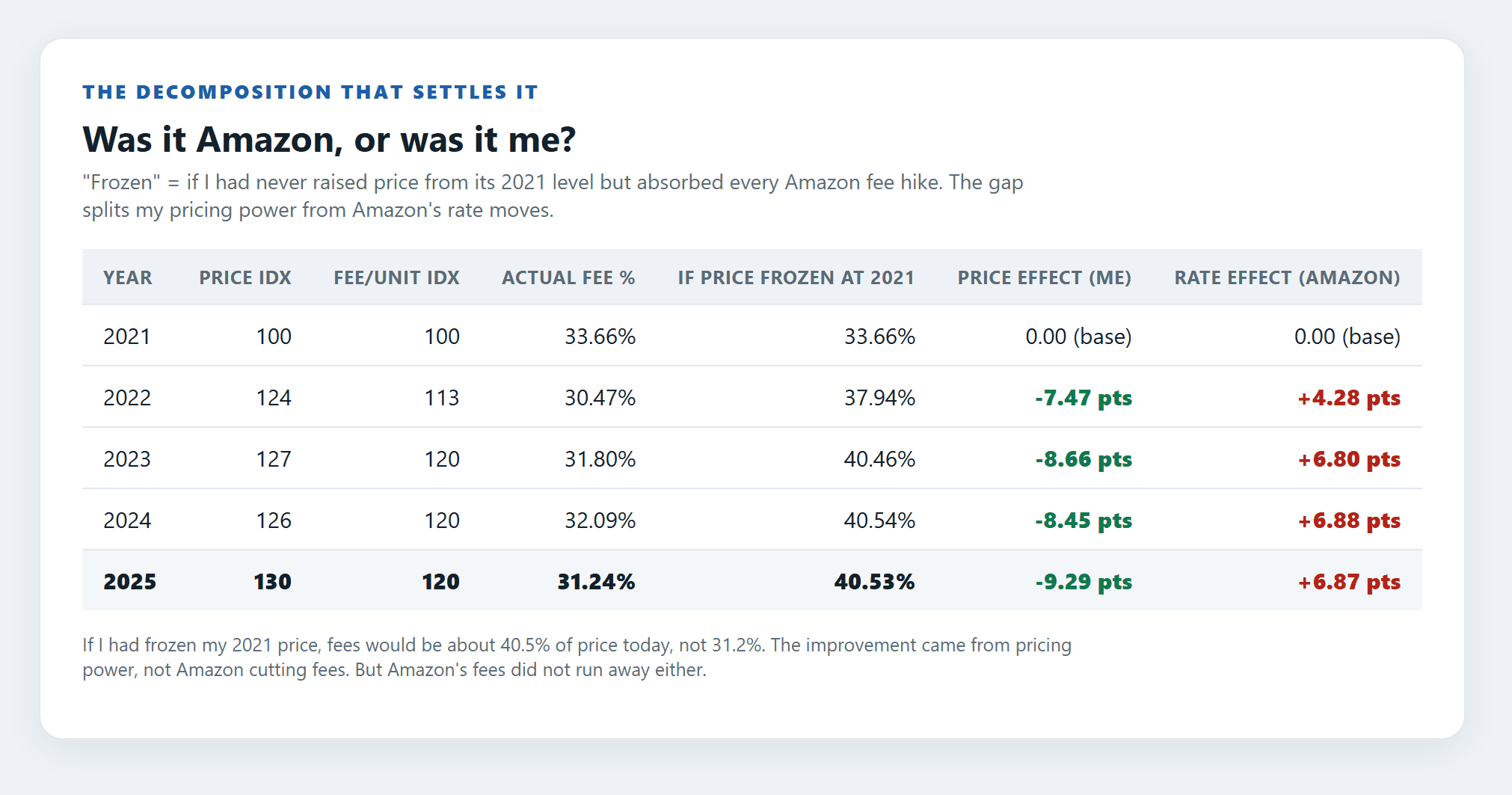
Was it Amazon, or was it me?
The honest part: the % only fell because I raised price faster than fees rose. If I’d frozen my 2021 price and absorbed every fee hike, fees would be about 40.5% of price today, not 31.2%. Amazon raised my per-unit fee about 6.9 points’ worth; I raised price about 9.3 points’ worth. My pricing power beat Amazon’s fee inflation every single year. The improvement is mine, but Amazon’s fees did not run away either. Also if you didn’t raise prices in the last five years, that’s kind of on you.
The referral fee did not change: it held at about 14.5% all five years (the Health & Personal Care rate for items over $10, not the 8% sub-$10 tier).
2) Amazon’s policy timeline
- 2022: Fuel and inflation surcharge (+5% on FBA): my per-unit FBA fee rose about +5.5%.
- 2023: Size-tier overhaul and “Small & Light” retired into Low-Price FBA: per-unit FBA peaked (about +10% year over year). Low-Price FBA is a sub-$10 program, so it did not touch my over-$10 product, but the de-aggregation ended the old structure where small or light products subsidized big or bulky ones.
- 2024: The pivot: Amazon CUT base fulfillment fees and added “behavior” fees (inbound placement, low-inventory, aged-storage). My per-unit fee dipped slightly. I triggered essentially none of them.
- 2025: No broad rate hike. Per-unit FBA fell to its lowest since 2022.
A straight-line extrapolation of my 2021 to 2023 trend predicted continued double-digit increases. Instead it plateaued. Putting a ceiling on small or light fulfillment fees, instead of letting small products keep subsidizing bulky ones, is exactly what a small supplement should have experienced.
3) The whole account
Beyond per-order referral and FBA, the account-level fees everyone fears (storage, inbound, placement, AWD, coupons, removals) total under 1% of revenue. Low-inventory-level fee: 0, never triggered. Aged-storage surcharge: 0. Reimbursements nearly offset the entire fee stack. And my per-order fees actually fell from 30.9% to 27.1% of revenue. What is rising: AWD and the new coupon-performance fee, both small (see the third image).
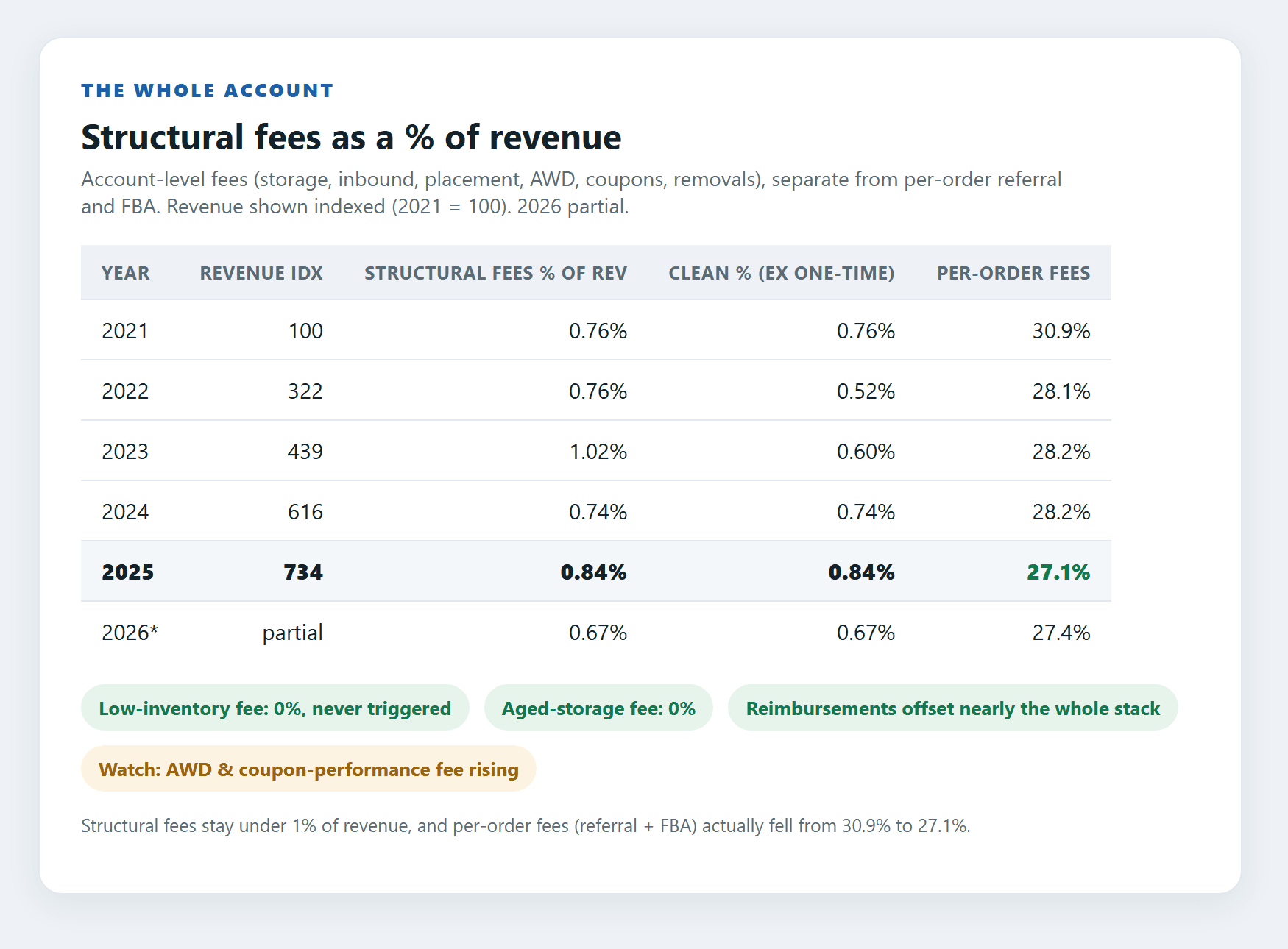
The AWD part everyone misreads
My AWD fees are rising, and it looks like a new cost. It is not. AWD now does what my outside 3PL used to do: receive bulk inventory, prep it, and feed FBA in smaller shipments. That 3PL cost lived outside Amazon, so it never showed up in any “Amazon fee” total. Now those dollars appear as “AWD.” The line going up is a cost moving into view, not a new cost. And routing through AWD deletes the fees that actually punish sellers: a SKU auto-replenished 70%+ via AWD is exempt from the low-inventory and aged-inventory fees, AWD includes inbound placement, and AWD storage runs about $0.38 to $0.48 per cubic foot vs FBA’s $0.99, and $3.63 in Q4 (Amazon’s published rates). AWD up while FBA storage, placement, and behavior fees go down is me using Amazon’s systems instead of leaning purely on FBA. Net landed cost flat or lower.
What this means
- My fees fell as a share of price (33.7% to 31.2%) and as a share of revenue (per-order 30.9% to 27.1%).
- Amazon’s per-unit fees did rise about +20%, but pricing power outpaced them. The fee complaint is often really a pricing-power problem.
- The 2024 behavior fees punish a profile, not everyone. Big, bulky, slow-turning, overstocked sellers got hit. Lean small-and-light operators triggered about 0%.
- De-aggregation helped small and light products by ending the old cross-subsidy.
- “Rising fees” often means cost moving onto Amazon. AWD replacing a 3PL looks like an increase but is often a net saving, and it deletes the punitive fees.
Caveat #1: this is one account, one category. Settlement data lags about 2 to 4 weeks, and 2026 is a partial year. Yours could look completely different. I’m not knocking anyone moving to TikTok; diversifying channels is smart. I just think it’s worth pulling your own numbers before blaming fees. Mine told a very different story than the headline.
Caveat #2: it takes real data and good data to be able to actually understand Amazon’s fees. I’m lucky because I built ExpandFi, which is quite literally the best platform that does this. However, I do think Amazon does one thing pretty bad, which is explaining these fees. They are complicated. They feel bad even when they might be good. To that, I hope Amazon improves their processes significantly.
I’ll follow up on this one with a cost of advertising view.