
Amazon's Subscribe & Save Top-Off Discount: What It Is, What It Costs, and Whether It Works
On July 23, 2026, Amazon extends Subscribe & Save discount pricing to reorders: extra units of a subscribed product, and reorders of eligible products. The seller funds it, and it is on by default. One question decides whether it is worth it. Does it make customers reorder more than they would have anyway, or does it just discount orders you were already getting? Here is what one brand’s data says.
TLDR
Amazon is extending your S&S discount to reorders through two programs: Top-Off for existing subscribers, and a new Buy Again & Save for past buyers who reorder without subscribing. Both are seller-funded, on by default, and apply at whatever S&S rate you set. About 95% of today’s activity is Top-Off, and measured on the same subscribers year-over-year they reorder about 18% more, roughly enough to cover the margin. A small, real win. Buy Again & Save is the risk: there is no basket minimum, so it reaches your full reorder base, and per Amazon’s latest guidance to sellers the opt-out is all-or-nothing: you are either in S&S, which now includes the expanded purchase types, or out of S&S entirely. Holding at 5% halves the cost but does not stop it. It also stacks on top of deals and coupons, so the all-in discount compounds during events. ExpandFi’s Promotion Performance Scorecard tracks both.
A living analysis. Amazon is still rolling this out and clarifying the mechanics, and the first post-July-23 reorder data has not landed yet. We are treating this as a living piece and will update it as we learn more. Last updated July 15, 2026.
Quick note: This is one anonymized supplement brand on ExpandFi, and every figure is indexed or shown as a percentage so nothing identifying is exposed. Treat it as a method to copy on your own data, not a benchmark to quote.
What is the Subscribe & Save top-off discount?
Subscribe & Save has always discounted a subscriber’s scheduled deliveries. Top-off applies that same discount to a different order: an extra unit outside the cadence, or a reorder of an eligible product. Not a coupon, not a subscription delivery. Just the S&S percentage on a one-off reorder.
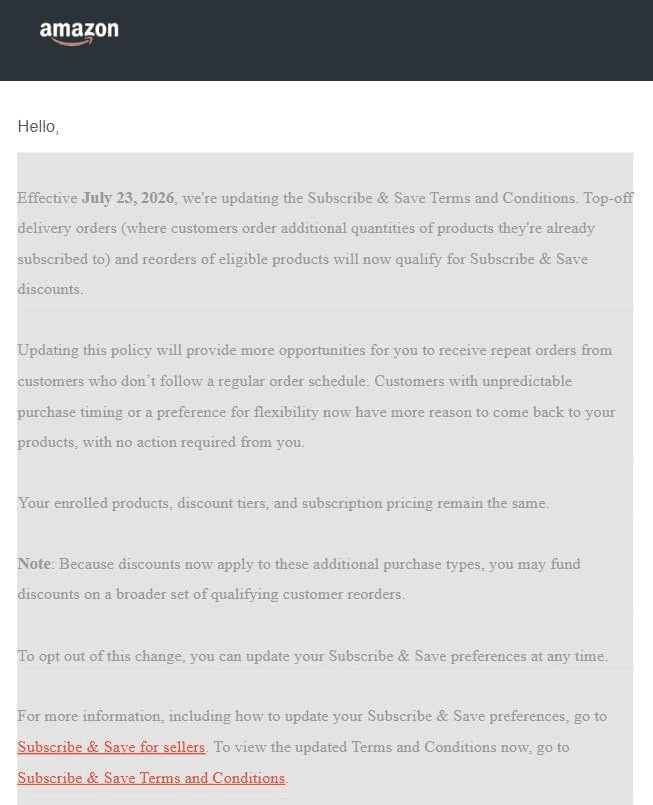
The announcement bundles two different programs, which Amazon has since clarified:
- Subscribe & Save Top-Off. A subscriber orders extra of a product they already subscribe to, at their S&S discount. Almost all of today’s activity, and the half that may be working.
- Buy Again & Save. A separate, new program. A Prime customer who bought a product before gets your S&S discount when they reorder it, without subscribing and with no basket minimum. A single eligible item qualifies. This is what July 23 opens up, and the half to worry about.
One point of confusion is worth clearing up. Amazon’s older “5 items in one delivery” rule, where Amazon funds an extra 5% on top of your discount, is a separate, pre-existing tier. It is not new, and it does not gate the July 23 expansion. The expansion triggers on a single eligible reorder, at whatever seller-funded rate you set.
Both programs run on your own S&S discount, with no Amazon funding. Everything measurable today is the first kind.
What the shopper sees, per Amazon’s guidance to sellers: a green checkmark with “Save 5% at checkout” (or your rate) next to the one-time purchase price on the detail page, and the same badge on the Buy Again grid. No strike-through price. The discount auto-applies at checkout, so the customer does nothing to claim it. The eligibility is same-ASIN only: a customer who bought one size or flavor does not get the discount on a sibling ASIN under the same parent. And it is not a one-time offer, it applies on every qualifying reorder. Amazon has not confirmed the lookback window that makes a past buyer “eligible”; its internal measurement references 12 months, which matches what we see in the data below (no cliff, a long tail).
Wait, is this actually new?
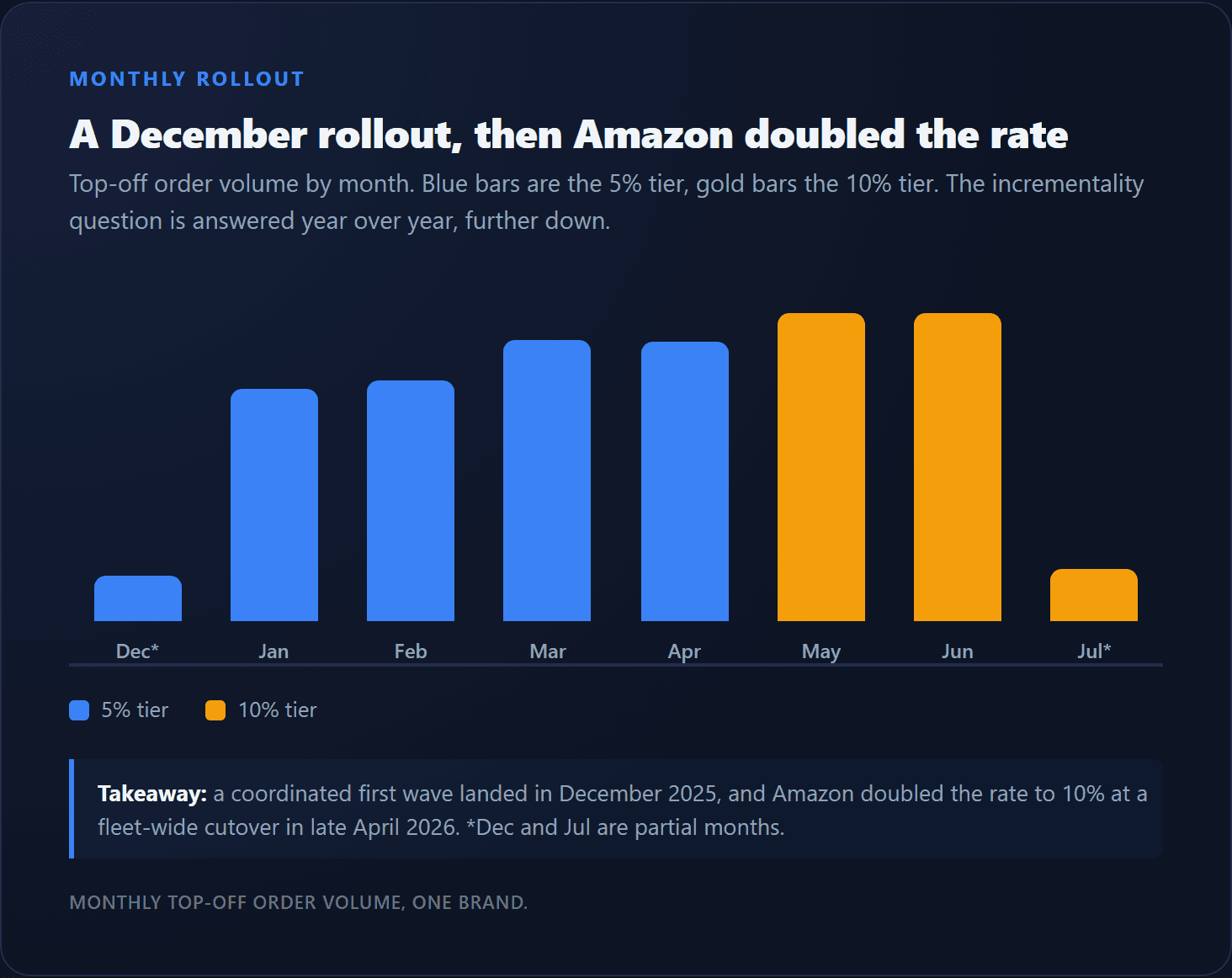
No. July 23 is the terms change, but the discount has run since December 2025. This brand’s first top-off order landed December 19. Of eight other supplement and consumable brands we checked, three started December 18, one day earlier, and five had none. A coordinated rollout, staggered by account. If you have not seen it, you are in a later wave.
Amazon has also moved the rate: 5% at launch, doubled to 10% at a fleet-wide cutover in late April 2026. Same promotion, twice the rate, five months in. The rate turns out to be the whole game for the economics.
Amazon’s guidance to sellers fills in the history: the program began as a pilot in the Pets category in late 2025, expanded to all categories in December (which matches the December 18-19 starts we observed), and was initially limited to ASINs enrolled at the 5% seller-funded tier before opening to the 10% tier in Q1 2026. Amazon’s own pilot numbers are striking: weekly customers redeeming top-off discounts more than doubled, subscriptions with top-off discounts retained about 100 basis points better than those without, and Amazon frames the whole program around the fact that roughly a third of subscribers were already making one-time purchases between deliveries. Two things to note about those numbers. They are gross program results, not an incrementality analysis, and Amazon has not shared anything separating new demand from cannibalized full-price orders. That question, the one that decides whether you profit, is the one this piece answers below.
Who actually qualifies for it?
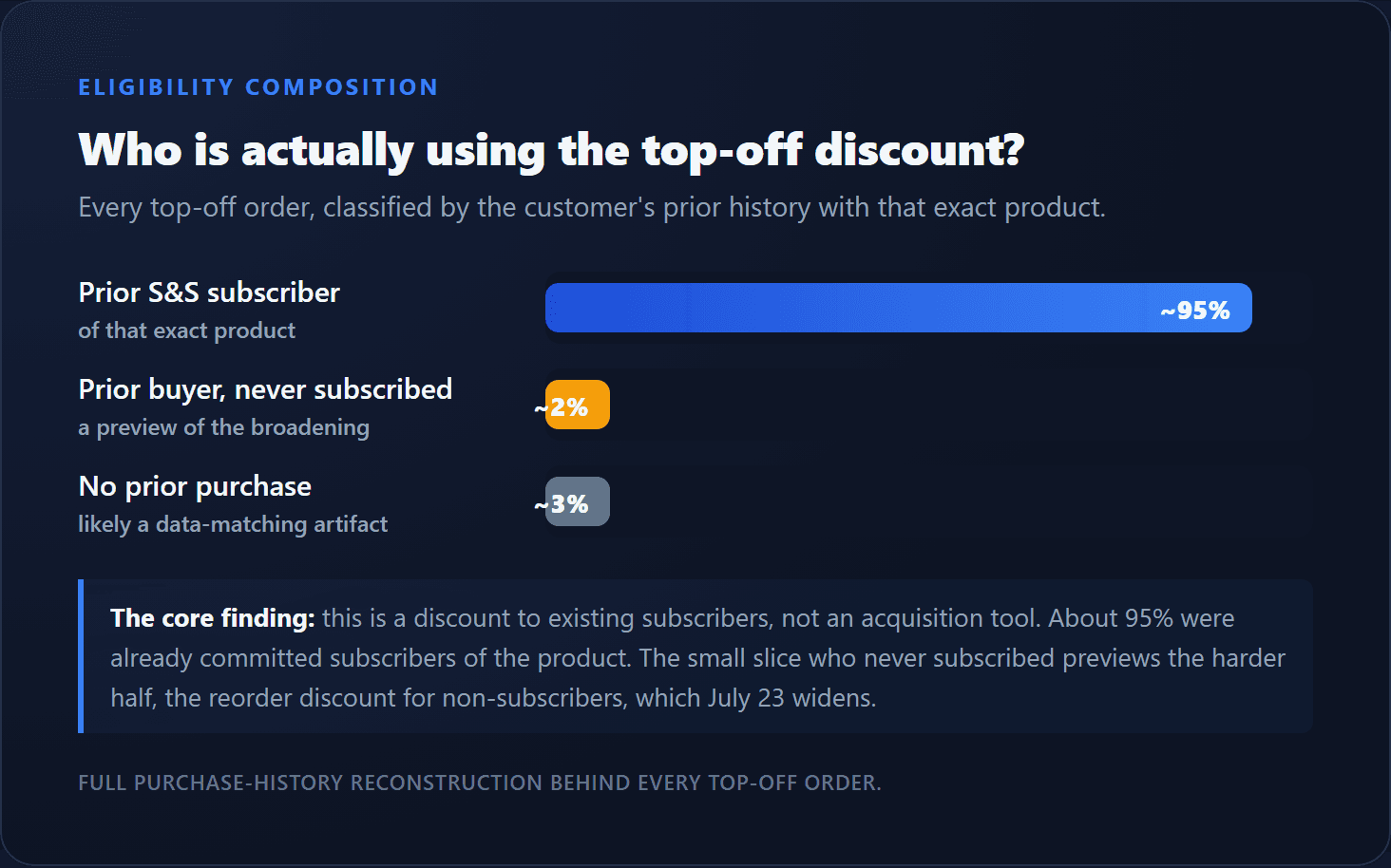
We reconstructed the purchase history behind every top-off order:
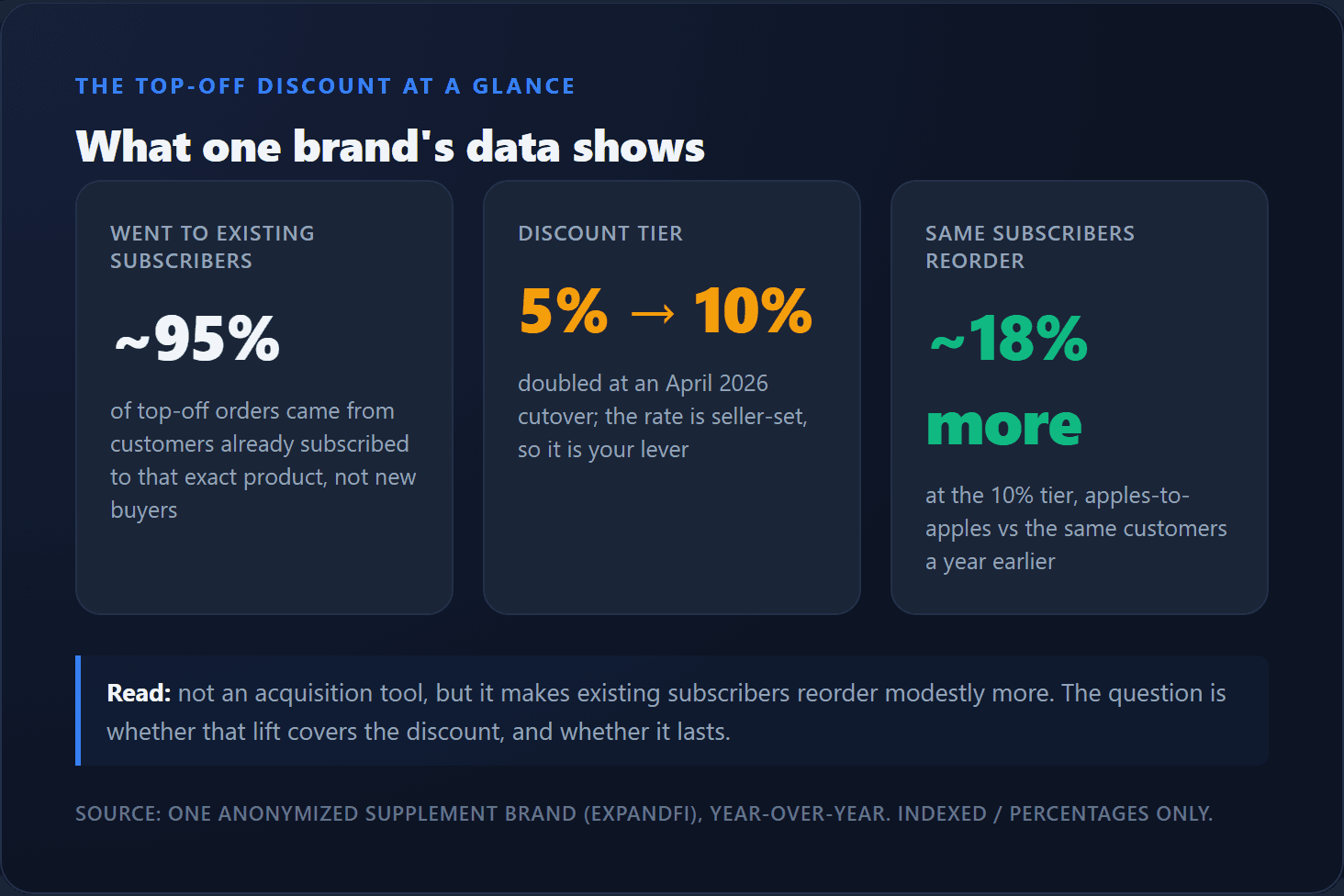
- About 95% came from customers with a prior S&S order of that exact product.
- Roughly 2% had bought it before but never subscribed.
- Under 3% had no prior purchase of it, most likely a data artifact.
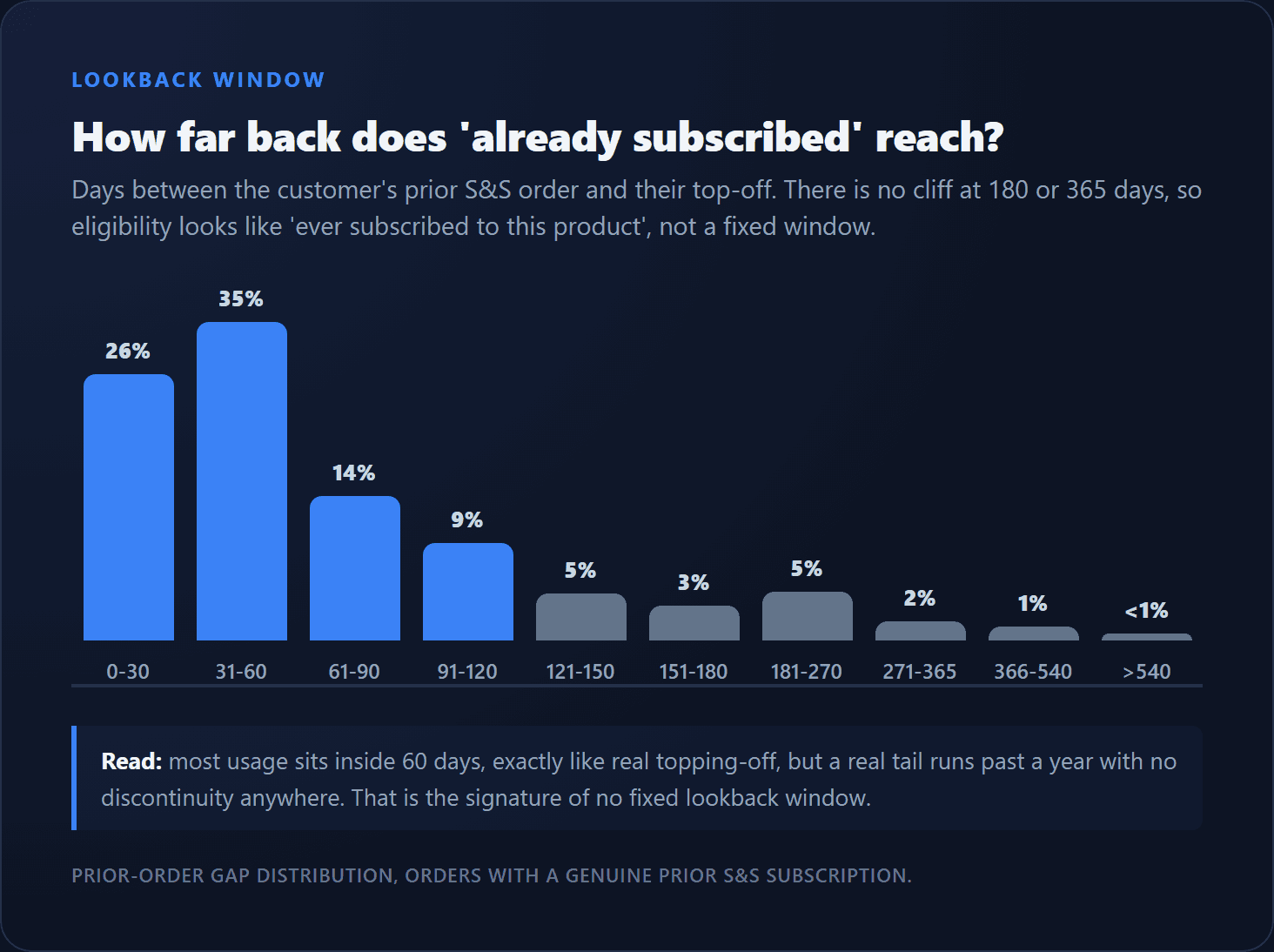
Two takeaways. This is not acquisition: almost no new customers. And eligibility travels with “ever subscribed to this product.” The median gap to a prior S&S order is about 50 days, but there is no cliff at 180 or 365 days, and a real tail runs past a year. Buying something else in between does not reset it.
Who funds it?
Amazon’s email (“more repeat orders,” “you may fund discounts”) reads like free retention. It is not, and Amazon has confirmed it: both programs use your existing S&S discount, and Amazon contributes nothing extra. S&S discounts are seller-funded, the 5 to 15% comes out of your proceeds. Every dollar of discount is a dollar off your own price, so the question is whether it buys anything.
The one question: is it incremental?
A discount can be incremental two ways, and they are easy to confuse.
Acquisition: does it bring in new customers? No. At 95% existing subscribers, it wins none, and the Scorecard grades it low on that.
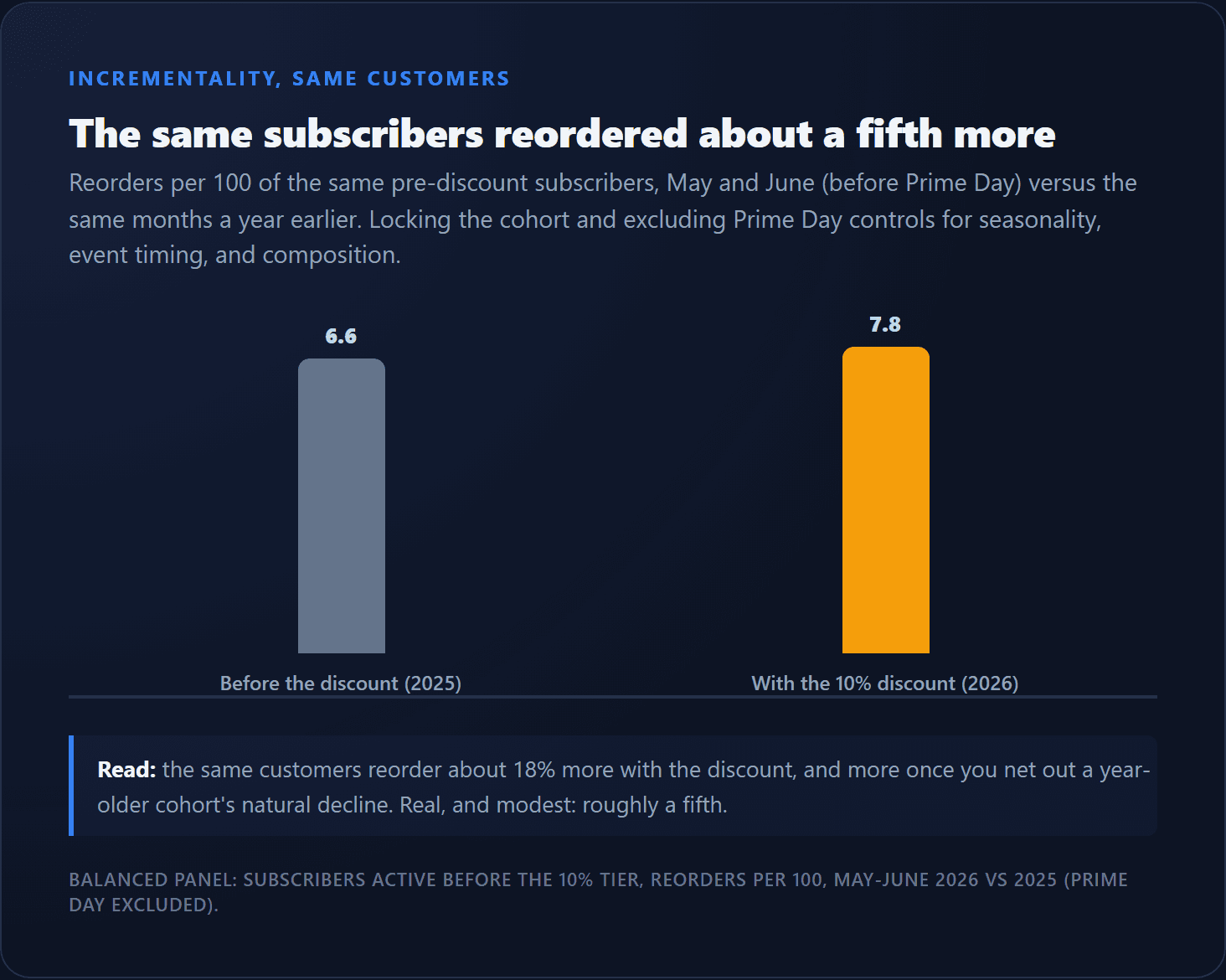
Frequency: does it make existing customers reorder more? That is the real test, and it needs a clean before-and-after. The trap is seasonality, since this launched in December and ran through the Q1-Q2 peak. So we compare year-over-year and lock the cohort: the same subscribers who were active before the discount, against what those exact people did in the same months a year earlier. We use May and June, before Prime Day, so the event does not distort either year.
The same subscribers reordered about 18% more at the 10% tier than a year before. A year-older cohort normally reorders slightly less, not more, so that 18% overcomes a real decline. The true effect is a bit larger. The lift is real and modest: roughly a fifth.
Does the lift pay for the discount?
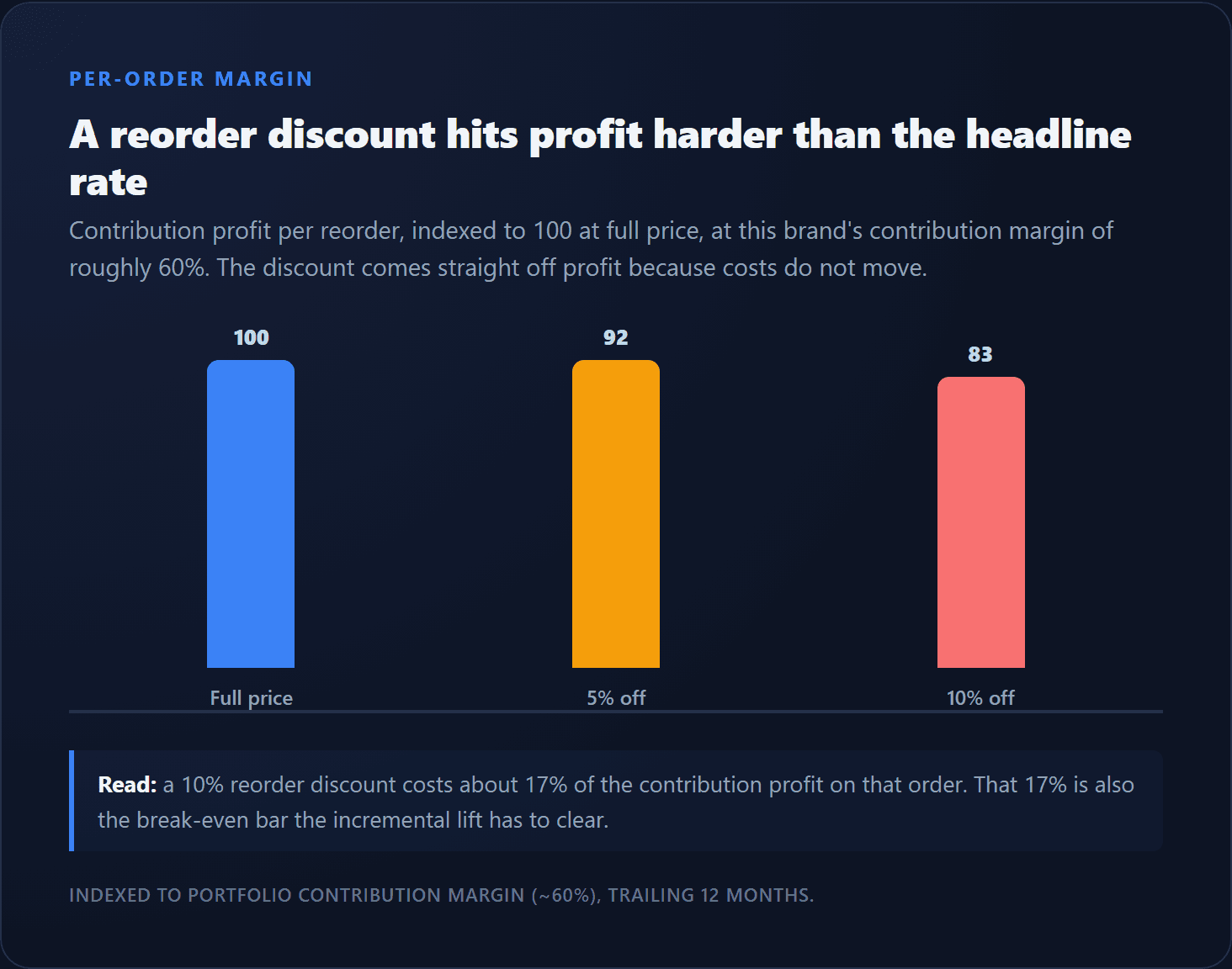
A lift only counts if it clears the margin it costs. At a contribution margin around 60%, the discount comes straight off profit, because costs do not move:
| Discount on the reorder | Contribution profit per order (indexed) | Change |
|---|---|---|
| Full price | 100 | baseline |
| 5% off | 92 | -8% |
| 10% off | 83 | -17% |
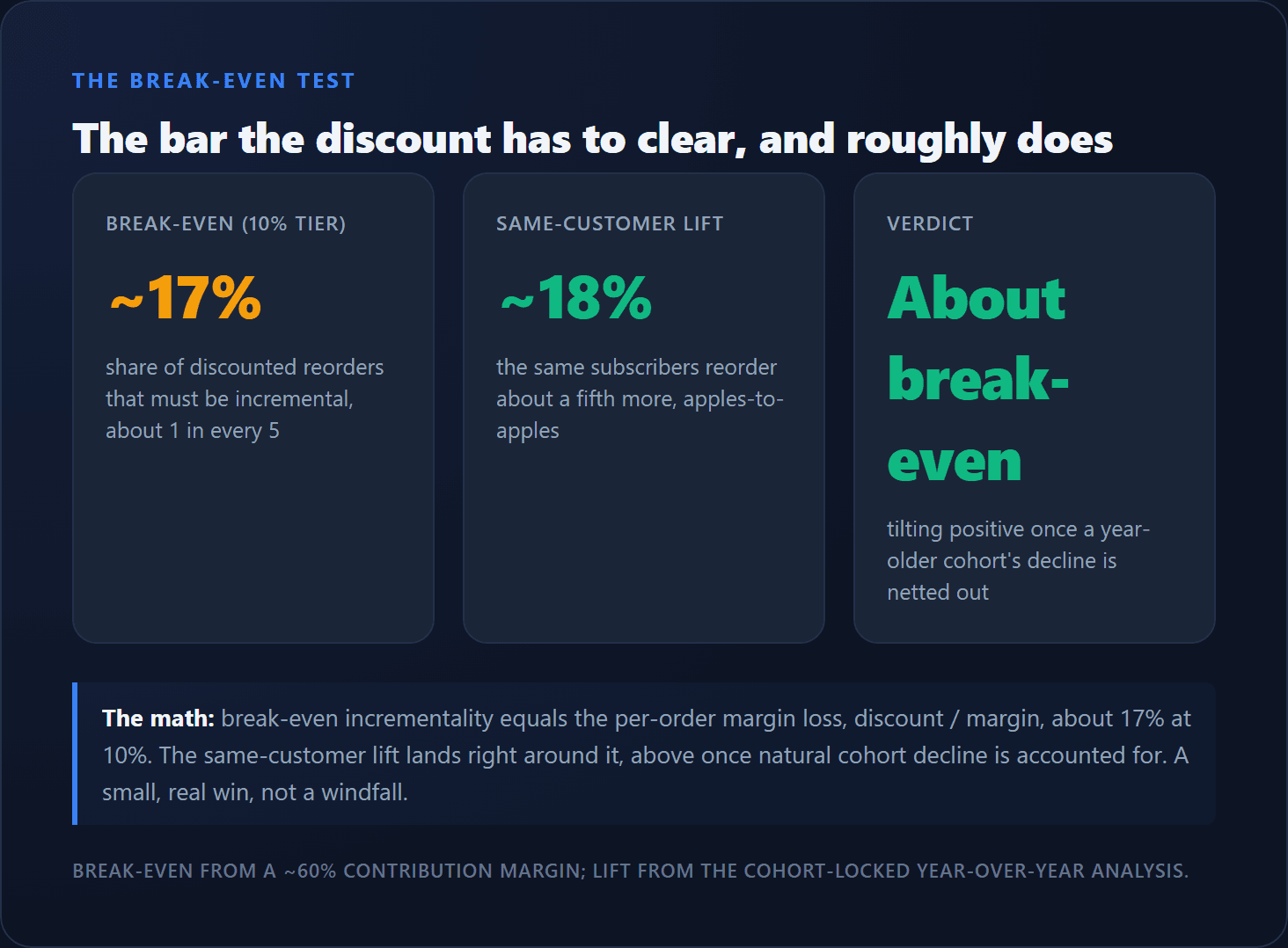
A 10% discount costs about 17% of the profit on the order, not 10%. That 17% is also the bar. The share of discounted reorders that must be incremental to break even equals discount divided by margin: about 17% at the 10% tier, 8 to 9% at 5%. One truly new reorder for every five that were coming anyway.
The 18% same-customer lift lands right around that bar, above it once the cohort’s aging is netted out. Not a giveaway, not a windfall. At 10% it about pays for itself, a bit better. A small, real win on the subscriber half.
The watch-item is pull-forward. If some of the lift is stock-up, it borrows from a future full-price order. The lift builds across months rather than spiking once, which argues against it, but it is early. Watch for a later dip below the prior-year line.
But don’t top-off users spend more?
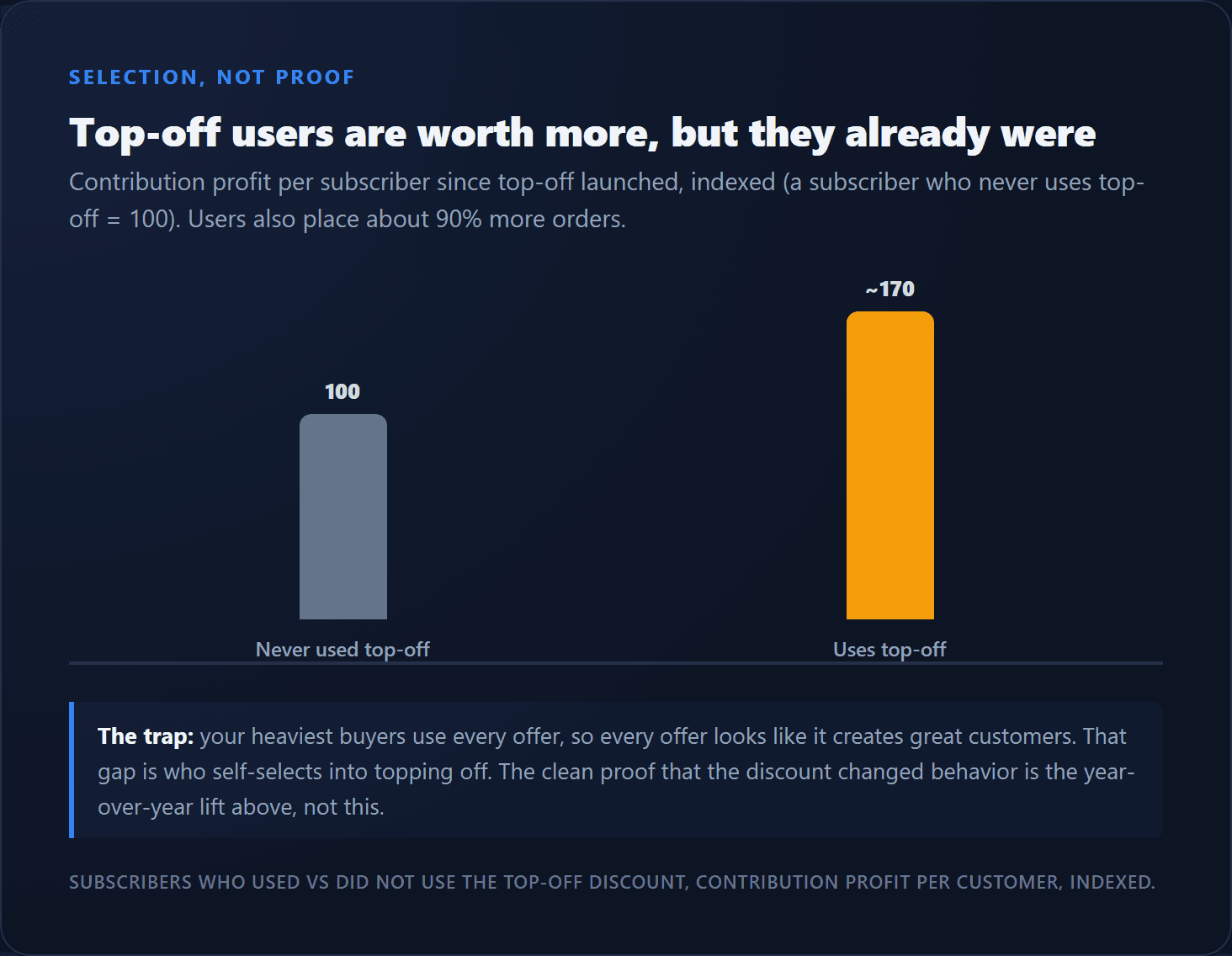
They do. Top-off users generate about 70% more contribution profit per customer than subscribers who never use it, and place about 90% more orders. That is not proof of incrementality. Top-off users are the heavy buyers who self-select into ordering extra. They place more orders because that is who they already were. Your best customers use every offer. To credit the discount you need the same customer buying more, which is the year-over-year test above, not this gap.
Measuring it: what the Scorecard tracks
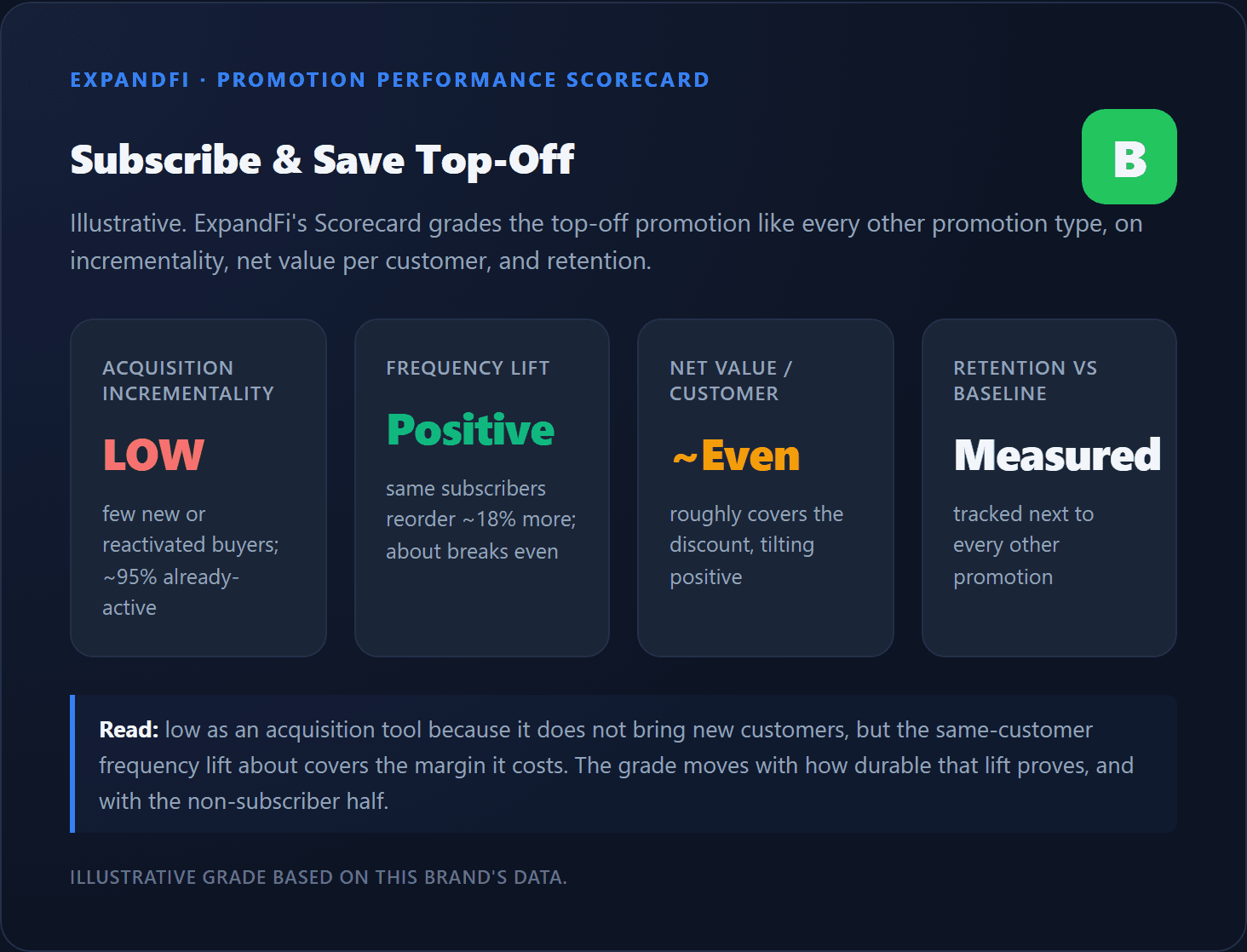
None of this shows up on its own in Seller Central. Amazon has confirmed that top-off orders just count as subscription units, folded into your S&S numbers, and Buy Again & Save flows into “Total Reorder” on the S&S dashboard. Neither is broken out as its own discount, so you cannot see what it costs. So we measure it directly. ExpandFi’s Promotion Performance Scorecard breaks the top-off discount out and grades it A to F, on the same scale as every other promotion. The row gives you:
- Incrementality (acquisition): the share of new or reactivated versus already-active buyers. Top-off scores low, correctly.
- Net value per customer: incremental revenue minus the discount you funded.
- Retention lift against a matched baseline, and a letter grade.
Every figure in this piece comes from that measurement.
The real risk: the non-subscriber reorder discount
The subscriber half may work. The other half, Buy Again & Save, is the risk. It gives your S&S discount to a Prime customer who bought a product before and reorders it without subscribing. No basket minimum, no cadence: a single eligible item qualifies.
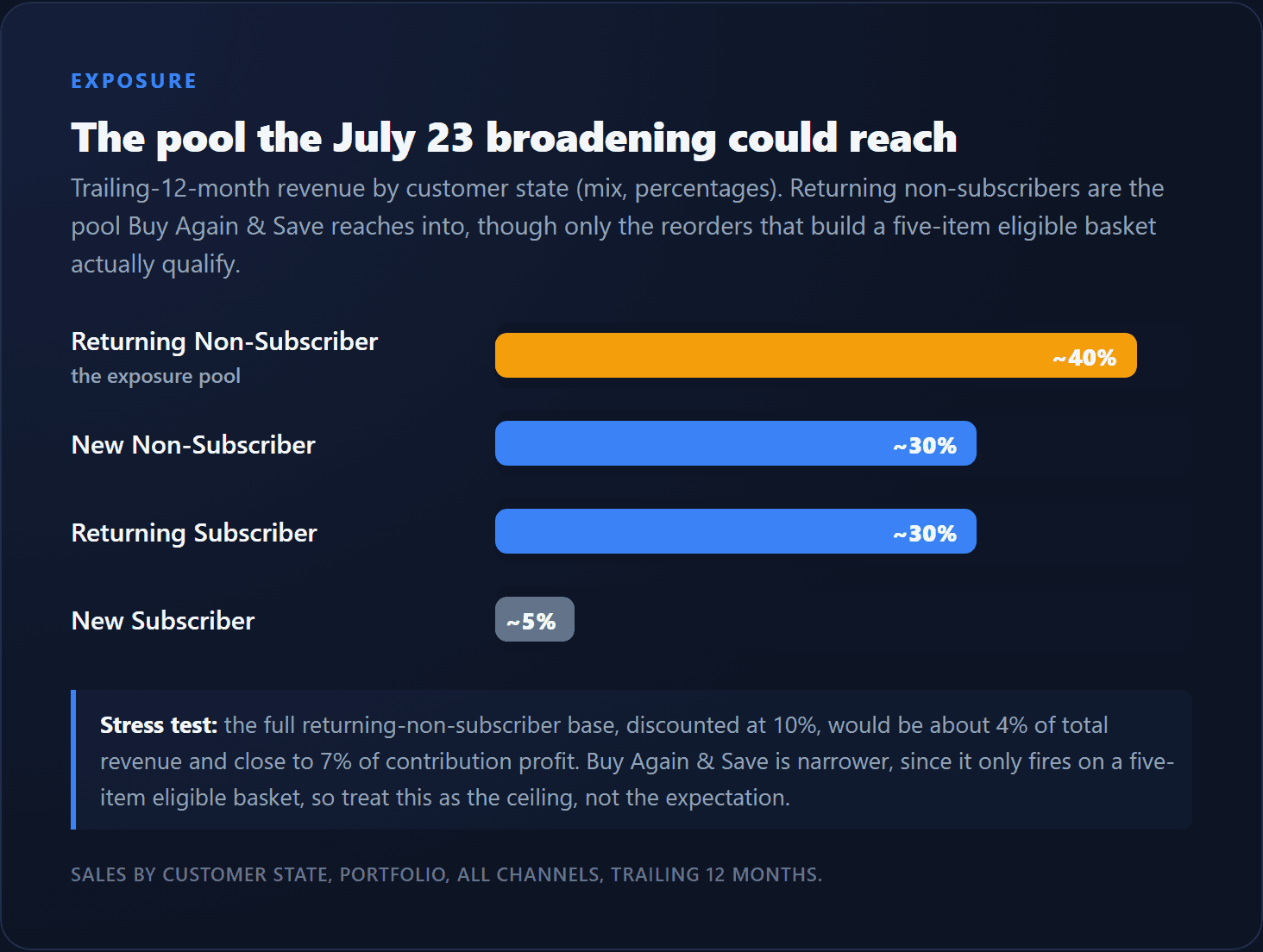
There is no gate to bound it, so the exposure is the full returning-non-subscriber base, about 40% of this brand’s revenue. It lands on customers who never chose a cadence, so some of it is margin on demand you already had. Whether the rest is incremental enough to cover its cost is the open question, and the closest precedent is encouraging (next). It applies at whatever S&S rate you set, both the 5% and 10% tiers, and the customer sees that rate. Dropping from 10% to 5% halves the cost but does not switch it off, which shapes the levers below.
Where it lands, the cost is the same. A 10% discount is about 17% of the profit on the order. And it does not stop at the order. Most of a repeat customer’s lifetime profit is reorders, and returning customers are about two-thirds of revenue, so discounting their reorders lowers lifetime profit itself. Lower LTP means a lower CAC you can afford.
It stacks on everything
One more mechanic, confirmed in Amazon’s guidance to sellers, that deserves its own warning: the expansion discount stacks on top of every other promotion type. It stacks on programmed deals (Lightning Deals, Best Deals, Prime Exclusive Discounts), on clipped coupons, on reorder coupons, and on S&S coupons.
Play that forward to your next deal event. A qualifying customer lands on an ASIN that is on deal and enrolled in S&S: they get the deal price, plus the expansion discount, plus any coupon they clip. Each layer looks reasonable alone. Stacked, a 20% deal plus a 10% expansion discount plus a 10% coupon is not a 20% event, it is closer to a 36% one, and at a 60% contribution margin that order is earning roughly half its normal profit before fees.
The practical move: before scheduling any post-July-23 deal, compute the stacked all-in discount for your S&S-enrolled ASINs, not just the deal discount. High-velocity, deeply-discounted events are exactly where the broadened eligibility compounds fastest, because deal traffic is heavy with past buyers, which is precisely who Buy Again & Save qualifies.
The reorder-coupon precedent
We do not have Buy Again & Save data yet, but we have its close cousin. A reorder coupon is almost the same thing: a discount that brings a prior buyer back for another order. This brand has run them for a while, and the Scorecard grades them.
They grade well. Across the brand’s reorder coupons, incrementality runs moderate to high, roughly 57% of the customers are new or reactivated rather than already-active, net value per customer is positive on nearly all of them, and coupon users return about 40% more than a matched baseline. Most earn a B or better. That is a discount reactivating customers, not just marking down demand that was coming anyway.
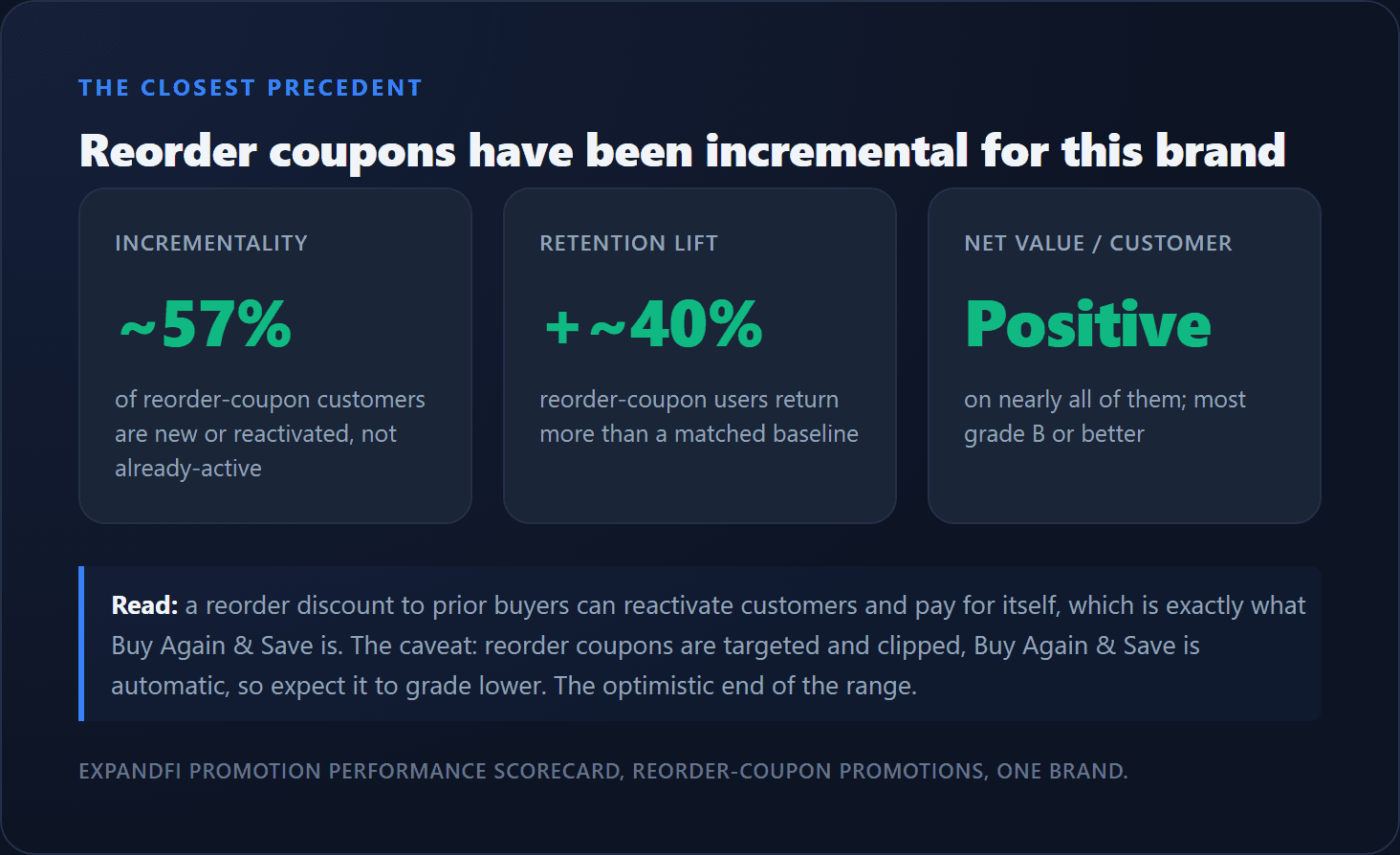
So the non-subscriber half is not automatically a giveaway. A reorder discount to prior buyers can pay for itself, and at this brand it has.
One caveat keeps it honest. Reorder coupons are targeted: the customer clips them, and they are usually aimed at buyers who are lapsing or overdue. Buy Again & Save is automatic on any qualifying reorder, so it will also discount customers who were going to buy regardless, which pulls incrementality down. Read the reorder-coupon result as the optimistic end of the range, not the expectation.
What it does to a $10 acquisition
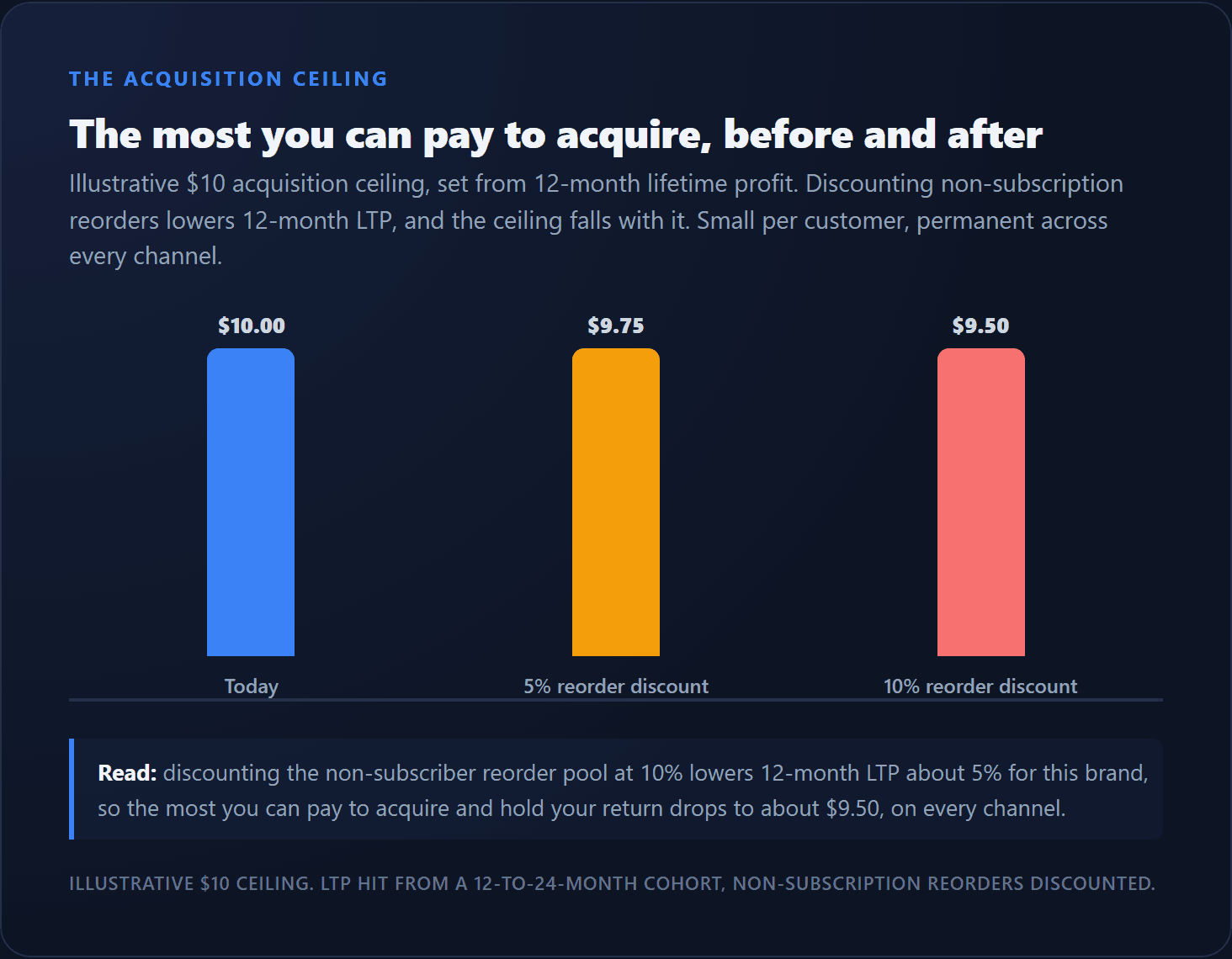
Say you can spend $10 to acquire a customer, based on their 12-month lifetime profit. Illustrative, but the mechanic is the point. Discounting non-subscription reorders at 10% lowers 12-month LTP about 5%. So the most you can pay and hold your return drops from $10 to about $9.50. Fifty cents on every acquisition, on every channel. And you underwrote the ads already running against the old $10, so profitable-looking spend was priced on a number that just shrank.
The levers you still control
Amazon turned this on by default, and the controls are blunter than they first appeared. The S&S discount is seller-set: 0%, 5%, or 10%, up to 15% in some categories.
- The opt-out is all-or-nothing. Per Amazon’s latest guidance to sellers, you cannot opt out of the expansion while keeping the standard S&S discount. You are either enrolled in Subscribe & Save, which now includes top-offs and non-subscriber reorders, or you opt out of S&S entirely. There is no granular off-switch for the non-subscriber half. So the real decision is whether the margin cost of funding discounts on a broader set of reorders outweighs losing S&S altogether. For most brands with real subscription volume, it will not, which makes the rate and offsets below the actual levers.
- Hold at 5% to halve the cost, not to switch it off. The expansion applies at both the 5% and 10% tiers, so 5% does not stop Buy Again & Save. What it does is cut the margin hit on every discounted reorder from about 17% to 8 to 9%. A real mitigation, not an off-switch.
- Drop S&S to 0% to remove it entirely. Zero rate, no discount for anyone. This gives up the subscriber program with it, so it is the nuclear option.
- Offset if you keep 10%. Raise the base price across the line to recover the roughly 17% per discounted order, or drive about 5% more volume to cover the lifetime-profit hit. Either absorbs the cost instead of avoiding it.
- Mind the stack during events. Since the expansion discount stacks on deals and coupons, the cheapest mitigation of all is scheduling: size deal discounts on S&S-enrolled ASINs with the stacked total in mind, or keep your deepest deals on ASINs where the reorder base is thin.
- Test the rate up, toward 15%, if the subscriber lift holds. At 10% it only about breaks even, so treat it as a test.
The upshot: the two halves ARE locked together. Staying in S&S now means accepting both the subscriber top-off and the non-subscriber reorder discount, so the real choices are the rate (5% vs 10%), price and volume offsets, and deal planning that accounts for the stack. Watch net value per customer and let the data pick.
Should Amazon reconsider this change?
Amazon’s goal is reasonable: make reordering easier, hand sellers more repeat orders. Shoppers get a better price, and on the subscriber half the seller may too.
The design is the problem, on the non-subscriber half. It is seller-funded, on by default, and reaches customers who committed to nothing. It hits the profit that funds advertising: lower lifetime profit means a lower CAC a seller can afford, which means less ad spend, which is Amazon’s own revenue. And it weakens Subscribe & Save itself, because if non-subscribers get the discount on reorders anyway, the reason to subscribe erodes. Three choices deserve a second look: on by default rather than opt-in, eligibility by product rather than by real subscription, and the full cost on the seller. At a minimum, let sellers scope it to their actual subscribers, the half that pays.
What we don’t know yet
- How durable the lift is. The clean evidence is the first months of the 10% tier. A later dip below the prior-year line would mean pull-forward, not new demand.
- How incremental the non-subscriber reorders are. With no basket gate, the discount reaches your full returning-non-subscriber base. How much of that is demand you already had, versus reorders the discount actually caused, is answerable only once it is live.
- The exact eligibility lookback window. Amazon has not confirmed whether a past buyer qualifies based on the last 12 months or lifetime purchase history; its internal measurement references 12 months.
- How hard the stack hits during events. Deal price plus expansion discount plus coupons compounds fastest on high-discount events, and the first post-July-23 event data will show how much margin that actually costs.
- How it ripples into subscribe rate, cancellations, and your new-versus-returning mix.
The bottom line
Good or bad depends on which half.
The subscriber half works, modestly. It does not acquire customers, but the same subscribers reorder about a fifth more, roughly enough to cover the margin, a bit better. Barring a pull-forward reversal, a small, real win.
The non-subscriber half, Buy Again & Save, is the bigger unknown. It discounts reorders from customers who never chose a cadence, and lowers the lifetime profit that sets your acquisition budget. The closest precedent, reorder coupons, has paid for itself here, but Buy Again & Save is less targeted, so expect less. July 23 turns it on across your full reorder base at whatever rate you set, it stacks on top of deals and coupons, and the only off-switch is leaving S&S entirely. Staying in means managing it: cut to 5% to soften it, offset it with price or volume, and plan deal events around the stacked total.
Take the win where the data shows one, guard the flank where it does not. In ExpandFi, the Scorecard breaks the discount out and grades it, so you can tell the half that pays from the half that does not, on your own numbers.
What comes next
The sharpest question is not yet answerable. The reorder discount for non-subscribers takes effect July 23; only when those reorders start flowing can we test whether they are incremental. Amazon is also still rolling out and clarifying the mechanics. We are treating this as a living analysis: as the mechanics firm up and the first post-July-23 data lands, we will run the same cohort-locked analysis and update this piece. The subscriber half is a modest win today. The non-subscriber half is the open question, and we will answer it with numbers.
See the top-off reports for your brand
Three reports in ExpandFi break this out on your own data, no query needed:
- Top-Off Sales by Period (Promotions, Top-Off): top-off sales by day, week, month, and quarter, split by channel.
- Subscribers vs Top-Off Users vs Non-Subscribers (Promotions, Top-Off): lifetime value and lifetime profit for the four customer groups, so you can compare top-off users against everyone else.
- Promotion Performance Scorecard (Promotions, Overview): grades the top-off discount A to F on incrementality, net value per customer, and retention, next to every other promotion you run.
Run this on your own brand
Every number here came from ExpandFi’s MCP. Connect it to Claude and paste this to run the same analysis on your account:
Using the ExpandFi MCP, analyze my Subscribe & Save top-off discount:

1. Find the promotion tagged "Subscribe and Save Top-Off". Show when it started, monthly order volume, and the discount rate over time, and state clearly whether Amazon changed the rate and when.

2. What share of top-off users had a prior Subscribe & Save order of the SAME product? Is this reaching existing subscribers or new customers?

3. Incrementality, done right: lock a cohort of subscribers who were active BEFORE the discount launched, and compare their reorder rate during the discount to what those SAME customers did in the same months a year earlier. Apples-to-apples, so it controls for both seasonality and the newer subscribers who would otherwise inflate the rate. Report the same-customer lift at each discount tier.

4. Break-even: at my contribution margin, what share of discounted reorders has to be incremental to cover the discount (it equals the discount divided by the margin)? Does the same-customer lift clear that bar? Flag pull-forward risk.

5. Cost side: what share of my revenue is returning non-subscribers (the July 2026 reorder pool), and how much does a 10% discount on those reorders lower my 12-month lifetime profit and the CAC I can afford?

Then give me a plain-English read: for my brand, is this discount incremental and worth it, or a margin giveaway?
New to ExpandFi? This is exactly the kind of question it is built to answer, on your own data.
FAQ
Does the top-off discount come out of my margin or does Amazon pay for it?
Your margin. S&S discounts are seller-funded reductions in your own price, and top-off uses the same mechanism. Plan as if you are funding it.
Is it incremental, or am I just discounting orders I would have gotten?
Both, by half. Measured on the same subscribers year-over-year, it lifts reorders about 18% at the 10% tier, roughly enough to cover the margin. The reorder discount for non-subscribers, which July 23 opens up, mostly discounts demand you already had. Grade the two separately.
How do I measure it without seasonality fooling me?
Compare year-over-year, each month against the same month a year earlier, and lock the cohort to the same customers. This launched into the peak season, so a prior-quarter comparison overstates the lift.
Who is eligible?
From one brand’s data, eligibility travels with having previously subscribed to that specific product, with no visible expiration window. About 95% of usage fits that. Amazon’s guidance to sellers adds three specifics: eligibility is same-ASIN only (a sibling size or flavor under the same parent does not qualify), the discount applies on every qualifying reorder rather than once, and Amazon has not confirmed the exact lookback window, though its internal measurement references 12 months.
Can I turn off the non-subscriber reorder discount?
Not by itself. Per Amazon’s latest guidance to sellers, the opt-out is all-or-nothing: you are either enrolled in Subscribe & Save, which now includes top-offs and non-subscriber reorders, or you opt out of S&S entirely. Dropping to 5% does not stop it either, the expansion applies at both tiers; a lower rate only shrinks the discount. The practical levers are the rate, price and volume offsets, and deal planning that accounts for stacking.
When does the change take effect?
The terms change July 23, 2026, but the discount is already live on some accounts, rolling out in waves.
Source: one anonymized supplement brand’s order history (ExpandFi), pulled 2026-07-08, with a cohort-locked year-over-year comparison, graded in ExpandFi’s Promotion Performance Scorecard and cross-checked against the Sales by Customer State report. Figures are rounded percentages, ratios, and indexed values. One-brand caveat applies.