
When Your Data Says "Spend More" — Do You Listen?
An 8-figure supplement brand on Amazon had a problem. Revenue dropped for five straight months — from over $2.1M/month down to $1.7M by December. Ad spend was flat around $150K/month. TACOS sat at 9-10%.
Their data said spend more. So they did. Here’s what happened.
The Setup
Five months of decline. Revenue down 20% from peak. Ad spend coasting at $150K/month. TACOS — Total Advertising Cost of Sale — around 9-10%.
What is TACOS?
Total Advertising Cost of Sale measures your total ad spend as a percentage of your total revenue — not just the revenue from ad clicks, but all revenue. A brand running 10% TACOS spends $10 in ads for every $100 in total revenue.
The question: cut spend to protect margins, or invest more to restart growth?
Most brands guess. This brand used ExpandFi.
What the Data Showed
Before changing anything, they checked three numbers inside ExpandFi that most brands never calculate:
- Customer Acquisition Cost (CAC) — what it actually costs to bring in a brand-new customer
- Lifetime Profit (LTP) — not revenue, but contribution profit after COGS, Amazon fees, and every variable expense
- The ratio between them (LTP:CAC) — for every dollar spent acquiring a customer, how many dollars of profit do they generate over 12 months?
Why Lifetime Profit matters more than Lifetime Value
Most brands track LTV — Lifetime Value, which is total revenue. But revenue isn’t profit. A customer who generates $50 in revenue but costs $40 in COGS, fees, and shipping is only worth $10. LTP shows you the real dollars that hit your bank account.
Here’s what they found on their flagship SKU:
$10 to acquire a customer. $33 in contribution profit over 12 months. 3.3x return. The math said there was room to spend more.
When LTP:CAC is above 2x, higher TACOS isn’t waste. It’s an investment with a known return.
The report that confirmed it was ExpandFi’s Spend Curve — CAC Profit Optimizer.
ExpandFi Report: The Spend Curve
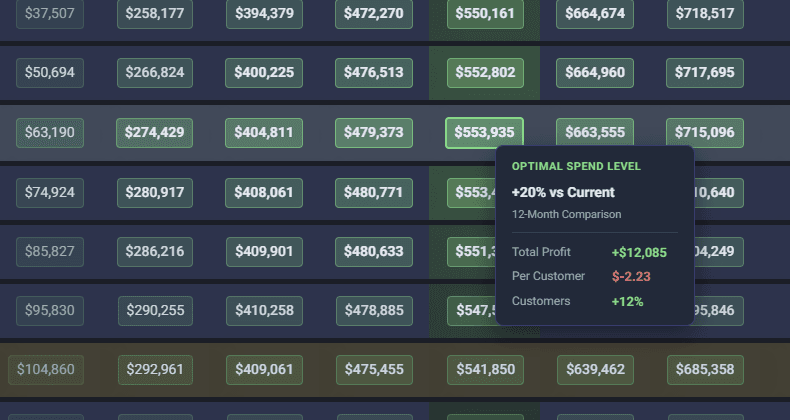
The Spend Curve models the relationship between ad spend and new customer acquisition for each product. It predicts how CAC will change at different spend levels, shows where diminishing returns kick in, and combines that with Lifetime Profit to show how much headroom you have. It answers: “If I spend 50% more, what happens to my CAC and my returns?”
On their flagship, the Spend Curve showed a 0.87 R-squared — the model explained 87% of the variation between spend and results. The spend response factor showed they were well below saturation. With a 3.3x LTP:CAC ratio and room on the curve, the answer was clear: spend more.
So they did.
What They Did
They ramped spend over 60 days:
- December: ~$150K (baseline)
- January: ~$170K (+15%)
- February: ~$240K (+65% from baseline)
They also put roughly $10,000 into external traffic — Meta and Instagram ads driving shoppers to their Amazon listings. This doesn’t show in Amazon’s reports, but it feeds the organic ranking algorithm: more velocity, higher search placement, more organic customers.
Total: about $100K more per month than before.
The Surface-Level Concern
After two months, the dashboard showed:
TACOS up. Margins down. If you stop there, it looks like a problem. But look deeper:
| Metric | Before (Dec) | After (Feb) | Change |
|---|---|---|---|
| Monthly Revenue | ~$1.7M | ~$1.9M | +15% |
| New Customers | ~14,000 | ~22,000 | +53% |
| Returning Customers | ~33,000 | ~35,000 | +8% |
| Total Customer File | ~47,000 | ~57,000 | +22% |
| Customer Acquisition Cost | ~$11 | ~$12 | +7% |
| CM% excluding ads | 52% | 53% | Stable |
That’s the difference between watching a dashboard and understanding a business.
What the Data Actually Showed
1. CAC barely moved
ExpandFi’s New Customers & CAC report tracks brand-new customer acquisition and cost per customer. They increased spend 65%. CAC rose 7% — from ~$11 to ~$12. They hadn’t saturated their market.
The signal to watch
If CAC rises in proportion to spend, you’ve hit saturation. If CAC barely moves while volume surges, you have room. The ratio between spend increase and CAC increase is the real signal — not TACOS.
2. Underlying margins didn’t change
ExpandFi’s Margin Trends Over Time report separates contribution margin with and without advertising. CM% before ads held steady at 53%. COGS, Amazon fees, operational costs — all stable. The margin compression was entirely from the choice to invest more in acquisition. 53% margin engine, 12% reinvested into growth, 41% left over. A decision, not a problem.
3. Ads were finding new customers, not recycling existing ones
ExpandFi’s Customers New vs. Returning report splits every customer into first-time buyers versus returning — something Amazon’s native reports don’t do. Returning customers grew independently, from ~33,000 to ~35,000/month. The ads were finding genuinely new buyers. The new customer mix shifted from 30% to 40%.
4. Customer quality held
Projected lifetime profit per customer: ~$24 for the February cohort vs ~$25 for December. A 4% difference. The customers acquired at higher spend had the same long-term economics.
5. The February cohort justified the spend on its own
Using LTP projections from the Spend Curve and LTP:CAC Economics reports: ~22,000 new customers in February, projected to generate over $500K in lifetime profit over 12 months. Ad spend that month: ~$240K. A 2.2x return — on profit, not revenue.
$240K in. $500K+ in projected lifetime profit. First 12 months only.
Three Months Later
By March:
| Metric | Dec (Trough) | Mar (3 Months Later) | Change |
|---|---|---|---|
| Revenue | ~$1.7M | ~$2.2M | +31% |
| New Customers | ~14,000 | ~26,000 | +85% |
| Total Customers | ~47,000 | ~63,000 | +34% |
| CAC | ~$11 | ~$12 | +7% |
| LTP per Customer | ~$25 | ~$24 | -4% |
Revenue at its highest in a year. New customers nearly doubled. Customer file at an all-time record. Per-customer economics barely changed.
The $10K in Meta/Instagram external traffic contributed too — it doesn’t show in Amazon’s reports, but it feeds organic ranking, Subscribe & Save enrollment, and the returning customer base that grew 12% on its own.
What They’re Watching
Scaling spend is continuous calibration. Here’s what stays on the radar:
TACOS above 15% on any full month is the tripwire. If it crosses 16%, they pull back.
LTP:CAC on the flagship needs to stay above 2x. Below that, the spend increase stops paying for itself.
Settlement lag means the true profitability picture runs 2-4 weeks behind. They don’t make reactive decisions on incomplete data.
The Point
This brand didn’t guess. They checked three metrics most Amazon sellers don’t track:
- True CAC — cost to acquire a genuinely new customer, not blended ACOS
- Lifetime Profit per customer — contribution profit after every cost, not revenue
- The ratio between them — does each new customer generate more profit than they cost?
When those numbers say go, higher TACOS is the cost of growth. Not a warning sign.
The brands that win aren’t the ones with the lowest TACOS. They’re the ones that know what a customer is worth.
3.3x LTP:CAC on the flagship. 53% margins underneath. No degradation in customer quality at higher volume. The Spend Curve said go. They went.
The ExpandFi Reports Behind This
Every number in this case study came from ExpandFi’s production reports. They update daily and run automatically.
The Spend Curve — CAC Profit Optimizer
Models ad spend vs new customer acquisition per product. Predicts CAC at different spend levels. Overlays Lifetime Profit to show headroom. The report that said "spend more."
LTV:CAC & LTP:CAC ASIN Economics
Long-term economics per product: revenue and profit at 1, 3, 6, 12, and 24 months vs acquisition cost. Generates Scale / Grow / Hold verdicts automatically.
New Customers & CAC
Brand-new customer volume and true acquisition cost over time. Not blended ACOS — actual ad dollars per genuinely new customer.
Customers New vs. Returning
Splits every customer into first-time vs returning, by product and channel. Proved ads were finding new buyers, not recycling existing ones.
Margin Trends Over Time
Contribution margin with and without ads, side by side. Shows whether margin compression is structural or the cost of growth.
Sales by Period by Channel
Revenue trending across channels, brands, and products. Weekly, monthly, quarterly, yearly.
These are production reports. Not spreadsheets someone had to build. The operator opened them, checked the numbers, and made a decision.
Why this matters
Most Amazon sellers make ad spend decisions on ACOS and TACOS alone. Those tell you what advertising costs. They don’t tell you what it’s worth. ExpandFi connects ad spend to customer acquisition to long-term profitability. The answer to “should I spend more?” becomes a number, not a feeling.
How This Was Made
This case study was written by Claude via ExpandFi MCP.
No human analyst pulled these numbers. Claude queried six ExpandFi reports, downloaded the data, ran the analysis across sales, customers, advertising, and profitability, and wrote this — in one session.
That’s how clean ExpandFi’s data is. An AI can connect to it, understand the metric relationships, and produce the same analysis an experienced operator would.
ExpandFi MCP v1.0 · 75 reports loaded · database online
When your data is structured enough for an AI to audit your business and get it right — imagine what it does for you.
Analysis performed by Claude (Anthropic) via ExpandFi MCP. Financials slightly modified for privacy. All ratios and trends are representative of actual data.